 UGX
 KES - Kenya
 TZS - Tanzania
 RWF - Rwanda
 NGN - Nigeria
 ZAR - South Africa
 USD - Zimbabwe
 GHS - Ghana
 ETB - Ethiopia
 ZMW - Zambia
 USD - International

Ask a Ugandan business owner what they paid themselves last month and many will laugh. The honest answer is “everything and nothing”: they took money from the business whenever the family needed it, and put money back in whenever the business ran short. That habit, more than any other, is what makes it impossible to know whether a business is succeeding.
Most guides on this topic start with bank accounts. This one starts with the decision that makes the rest work: how you pay yourself.
Step 1: Decide how the owner is paid
Drawings, salary or both
- Sole proprietors and partners take drawings: money transferred from the business to the owner’s personal account. Drawings are not an expense; they are profit being taken out.
- Owners of a company registered with URSB are, legally, separate from the company. Directors who work in the business are usually paid a salary through payroll, with PAYE and NSSF where they apply; NaliSuite’s PAYE payroll works these out. Profit beyond that can be paid as dividends when the company declares them. Your accountant can advise on the right combination.
Choosing an amount
- Look at the last few months of sales and costs, even if the records are rough.
- Estimate a typical monthly profit, then take a cautious share of it as your pay, leaving the rest in the business for stock, emergencies and growth.
- Write the amount down and pay it on the same day each month or each week.
- Review it every quarter once you have clean figures.
The amount matters less than the regularity. A modest fixed pay you can rely on is better than large, unpredictable withdrawals.
Step 2: Give the business its own accounts
Mobile money
Customers should pay a business number, not your personal one. Ask MTN or Airtel about a merchant account, or use a second SIM and wallet only for business. Put the business number on your receipts, invoices, signboard and social media pages.
Bank
Open a bank account used only for the business, and sweep the mobile money balance into it on a fixed day. A registered business will usually be asked for its URSB documents and URA TIN when opening an account.
Cash
Bank your cash takings regularly instead of paying for things from the drawer.
Step 3: Move personal costs out
Rent at home, school fees, family support, introduction ceremonies and church contributions come out of your personal account, which is funded by your pay. If the business must help one month, record it as a loan to the owner and repay it.
Step 4: Record and reconcile
Receipts
Keep the invoice or receipt for every business payment. In NaliSuite Purchases, you can photograph a supplier bill and Document AI fills in the details for you to check.
A weekly check
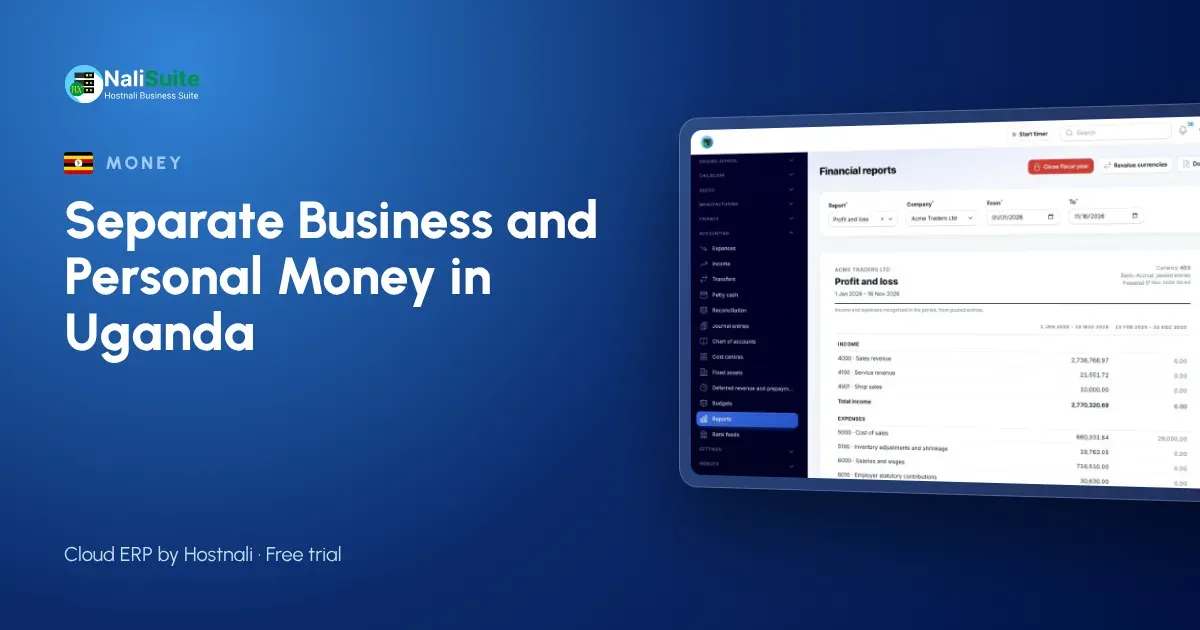
Every week, go through the business mobile money and bank statements and explain every line. Bank and mobile money reconciliation imports the statements and suggests matches against invoices and bills, so anything personal that slipped through stands out quickly.
An example: Grace’s salon in Ntinda
Grace runs a hair and beauty salon in Ntinda, Kampala, with four stylists. Clients pay by MTN MoMo to her personal line, or in cash. She buys products, pays the stylists and pays her own household bills from the same wallet.
What she decided:
| Decision | Detail |
|---|---|
| Owner pay | A fixed amount every second Friday, transferred as drawings |
| Business wallet | MoMo merchant account; number on mirrors and receipts |
| Bank | Business account; wallet swept every Monday |
| Stylists | Paid commission from the business account with a payslip |
| Products for home | Recorded at cost as drawings |
After three months of clean figures, her monthly profit and loss statement shows that braiding is her most profitable service and that one expensive product line barely sells. She cuts the product line and adds a braiding stylist, and increases her own pay at the next review.
When the business needs your money
Sometimes the flow runs the other way: the business is short and you put in your own money to pay a supplier or the rent. That is fine, but record it as capital or as a loan from the owner, not as a sale. When the business recovers, repay the loan from the business account. Recording money in both directions keeps the business’s results honest and shows you whether it is really standing on its own feet.
Signs you are still mixing
- You top up the business from your personal account more than once a month.
- You cannot say what you paid yourself last month.
- Customers still pay your personal number.
- Your accountant finds personal payments in the business statement at year-end.
Frequently asked questions
How much should I pay myself?
There is no set figure. Start with a cautious share of typical monthly profit and review it each quarter.
Are drawings tax-deductible?
No. Drawings are profit taken out and do not reduce taxable profit. A salary paid to a company director through payroll is treated differently; ask your accountant.
Do I need to register with URSB first?
No. A dedicated wallet and account are a good start, but registration makes business banking and credit easier.
Will this help with a loan application?
Yes. Lenders read statements; clean ones help. See our guide to records for a business loan in Uganda.
Try NaliSuite
Pay yourself properly and see the business’s real profit with NaliSuite Accounting, from UGX 8,500 a month with a free trial. See the plans.