 UGX
 KES - Kenya
 TZS - Tanzania
 RWF - Rwanda
 NGN - Nigeria
 ZAR - South Africa
 USD - Zimbabwe
 GHS - Ghana
 ETB - Ethiopia
 ZMW - Zambia
 USD - International

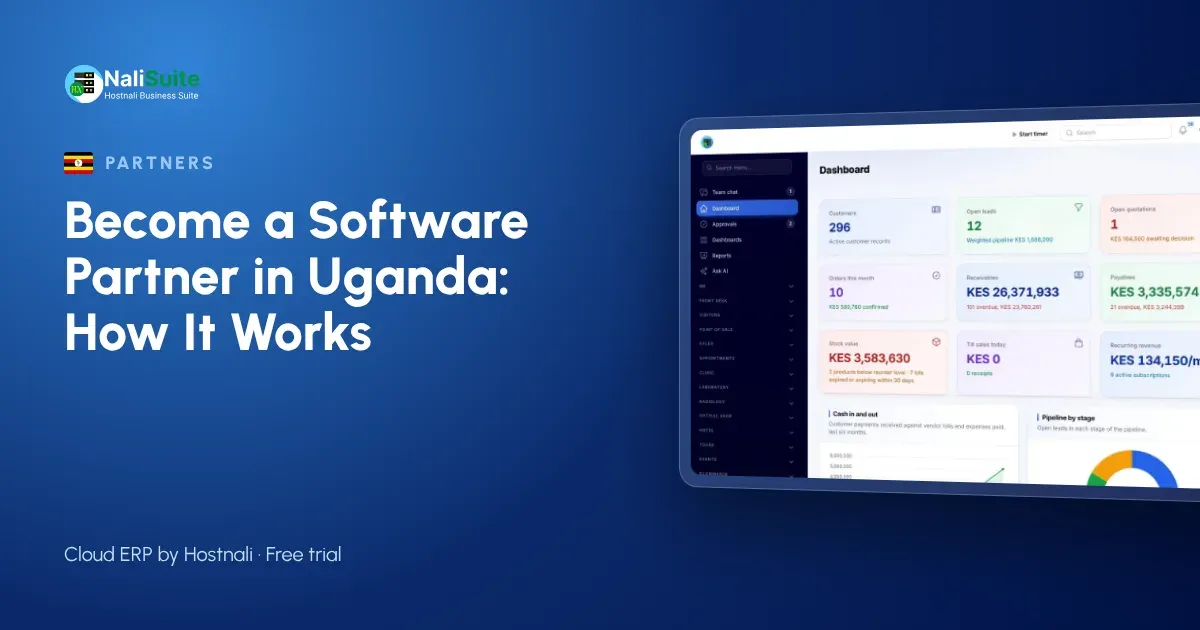
Small firms in Kampala that do bookkeeping, IT support or web design often hear the same request from clients: “Can you just sort out our system?” A software partnership gives you a ready answer, a repeatable service and a share of every subscription you bring in.
Below is a plain explanation of the NaliSuite partner programme for Uganda, the kind of firms that do well with it, and how a partner’s first year usually unfolds.
The programme in one paragraph
NaliSuite is cloud business software with 17 built-in apps, from invoicing and accounting to stock, payroll, CRM and projects. Through the partner programme, accountants, consultants, IT companies and web agencies refer or resell it to their clients, help with setup, and earn 20% recurring commission on the subscriptions they bring in, every billing period, for as long as the client stays. Plans start from UGX 8,500 a month. Terms are on nalisuite.com/partners.
Firms that tend to do well
The bookkeeper with a loyal client list. Twenty small clients who send receipts by WhatsApp every month are twenty reasons to move onto one system you can log in to.
The IT support company. You already visit offices in Kampala, Entebbe and Jinja to fix printers and email. Setting up the software those offices run on is a natural next service.
The web agency. Your clients want their website to bring in customers. NaliSuite turns those enquiries into leads, quotations and invoices, so you can show results beyond page views.
The Hostnali reseller. If you already resell hosting, business software gives you a second recurring product for the same clients.
A partner’s first year
Months one to three: learn and prove. Set up a demo company and move two or three clients who trust you. Keep notes on every question they ask.
Months four to six: package it. Turn those notes into a fixed setup service with a clear scope. Decide what training you include and what support costs.
Months seven to nine: specialise. Pick one or two sectors you know, such as retail, schools or clinics. The industries hub shows which add-ons suit each one, and repeat setups get faster.
Months ten to twelve: grow. Ask happy clients for referrals. Each new client adds to the recurring commission while the earlier ones keep paying.
Running the first setup meeting
Most of a good setup is decided in the first hour with the client. Bring a short agenda:
- Walk through a normal day. Who takes orders, who handles cash and mobile money, who orders stock, who pays staff.
- List the documents they produce, such as quotations, delivery notes, invoices and receipts, and collect one example of each.
- Agree the users. Each person who logs in needs an account and a role, which also decides the plan size.
- Pick a start date, ideally the first day of a month, and agree which balances will be brought in.
- Choose what goes live first. For most Ugandan small businesses that is invoicing, payments and the books, with stock and payroll a few weeks later.
Write the answers into a one-page summary and send it to the owner the same day. It shows professionalism, and it protects you if the scope later grows.
Setting up Ugandan clients properly
A setup feels local when these details are right:
- Mobile money. Connect mobile money payments so customers can pay invoices with MTN MoMo or Airtel Money.
- Tax details. Record TINs for customers and suppliers where needed and set VAT in the country pack. Check current rules with the Uganda Revenue Authority.
- Payroll. Payroll handles statutory deductions for Uganda in the country pack; the client can set rates in NaliSuite’s settings where they change.
- Data protection. You will see staff and customer records. Follow the Data Protection and Privacy Act 2019 and the Personal Data Protection Office’s guidance, and agree in writing what you can access.
Answering common client objections
“We already use Excel.” Show how an invoice in NaliSuite becomes a payment record and a ledger entry without retyping. Excel can stay for analysis.
“Our internet is not always reliable.” The point of sale keeps selling offline and syncs when the connection returns.
“It will take too long to set up.” Start with invoicing and payments only. Add stock and payroll later.
“We are on QuickBooks.” The QuickBooks and Xero sync add-on can keep both connected during the move.
How to apply
- Apply on nalisuite.com/partners.
- Receive your partner account and materials.
- Set up your first clients and earn 20% of their subscriptions.
Frequently asked questions
Do my clients have to sign up through me?
To earn commission, the client’s subscription needs to come in through you as their partner. The full rules on how clients are linked to partners are in the terms on nalisuite.com/partners.
Who can become a partner in Uganda?
Accountants, bookkeepers, consultants, IT companies and web agencies that work with small and medium businesses.
How is commission calculated?
It is 20% of the subscriptions you bring in, every billing period, for as long as the client stays on NaliSuite.
Can I set my own setup fees?
Yes. Your setup, training and support fees are agreed between you and your client.
Try NaliSuite
Open a free trial of NaliSuite, set up a sample business with MTN MoMo payments and use it as your demo for the first client conversation.