 UGX
 KES - Kenya
 TZS - Tanzania
 RWF - Rwanda
 NGN - Nigeria
 ZAR - South Africa
 USD - Zimbabwe
 GHS - Ghana
 ETB - Ethiopia
 ZMW - Zambia
 USD - International

“Customer support” sounds like something for telecoms companies and banks. In reality, any Ugandan organisation that deals with the public runs a support desk, whether it calls it that or not. A school office answering parents, a clinic reception, a property agent or an insurance broker all field the same kinds of questions every week.
This guide looks at support ticketing through the eyes of a private school in Kampala, organised around the types of question it receives. The same approach works for any service business.
The example: a school office in Kampala
A primary and secondary school in Muyenga, Kampala, has around 900 pupils. Its office team of four takes calls, WhatsApp messages, emails and walk-in visits from parents all day. Before ticketing, questions were answered by whoever picked up, and nobody could tell a parent with confidence whether their earlier request had been dealt with.
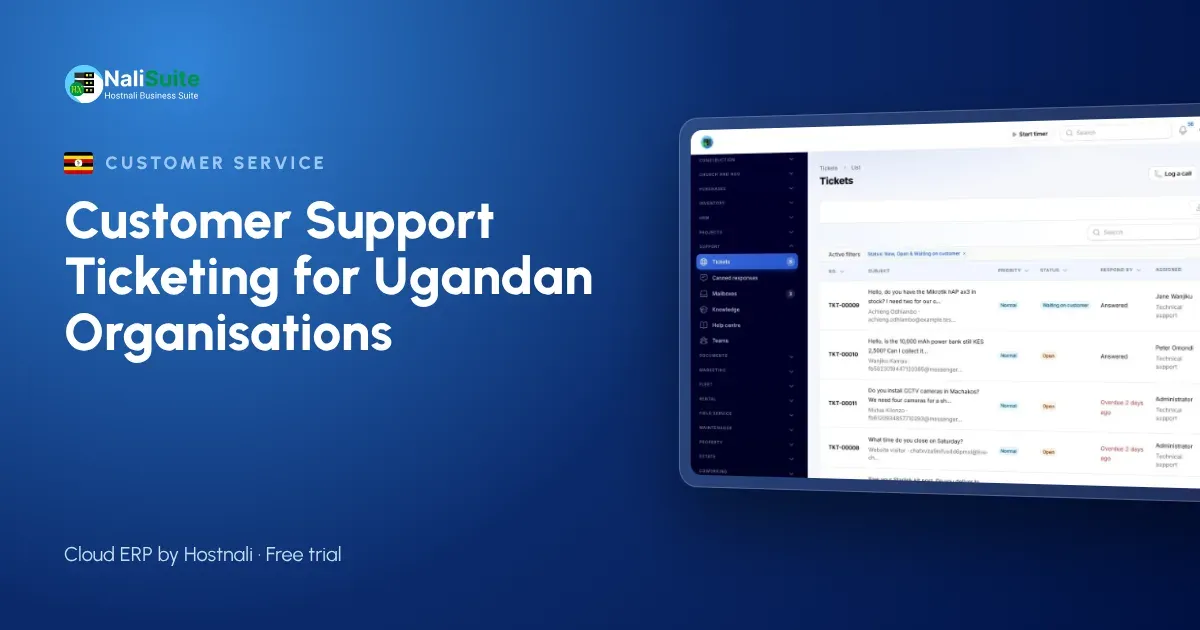
The school moved every channel into NaliSuite Helpdesk: email, the website contact form, phone calls logged by the office, Facebook and WhatsApp through the WhatsApp Business Cloud API. Every question is now a ticket with an owner, a priority and a status.
Sorting questions by type
The biggest improvement came from grouping tickets by topic and giving each topic a team.
Fees and payments
“Has my payment reflected?”, “Can I pay in instalments?”, “Please send the term invoice.” These go to the bursar’s team. With fees invoiced from NaliSuite Invoicing, the bursar can check the parent’s account straight away. Parents pay by MTN MoMo, Airtel Money or card, and mobile money payments are recorded against the right invoice, which removes most “has it reflected?” questions on their own.
Transport
Route changes, pick-up times, a bus running late. These go to the transport coordinator and are often urgent on school mornings, so they carry a higher priority.
Admissions
Enquiries from prospective parents. These are sales, really, and a slow reply loses a family to another school. Admissions tickets have a short first-response target.
Academic and welfare
Questions about reports, homework or a child’s wellbeing go to the relevant teacher or the deputy head. These need care rather than speed, and the ticket keeps a record of what was discussed.
Complaints
Anything marked as a complaint goes to a senior member of staff, with escalation if it is not resolved within the target time.
One parent, one history
Because every ticket is linked to the parent’s contact record, the office can see at a glance that a mother who calls about transport also asked about a fee balance last week. The conversation picks up where it left off, and the parent no longer has to repeat the story to a different person each time.
Priorities and targets
Helpdesk tracks first-response and resolution targets by priority and escalates tickets that are close to missing them. The school uses:
- Urgent: safety or transport problems on the day, first reply within 15 minutes.
- High: admissions and complaints, first reply within two hours.
- Normal: fees, reports and general questions, within one working day.
- Low: suggestions and feedback, within three working days.
Choose targets you can keep, then improve them.
Fewer questions in the first place
Most parents ask the same things at the start of each term: term dates, fee structure, uniform, requirements lists. The school wrote these up as articles in a public help centre and in the customer portal, and links to them in canned replies. With the School Management add-on, parents can also be kept informed through a parent portal.
In the customer portal, parents see their invoices, pay outstanding ones and follow their tickets without visiting the office.
Replying faster, but carefully
Canned replies handle the routine. For the rest, the AI Business Assistant add-on can draft a reply from the conversation and the school’s help articles, using the school’s own Anthropic API key. A staff member always reads and edits the draft before it is sent.
What the school learned
After one term, the office reviewed its tickets:
- Fee questions fell sharply once payments reflected on invoices automatically.
- Transport tickets spiked on rainy mornings, so the coordinator now sends a short update on those days.
- Admissions replies within two hours led to more school visits being booked.
Children’s and parents’ data
Tickets may include pupils’ names, health notes and family details. These are personal data under Uganda’s Data Protection and Privacy Act, 2019, and information about children needs extra care. Keep it in the helpdesk, not on staff phones, and give each team access only to the topics it handles.
Busy times of the school year
The start of each term and the days before exams bring a flood of questions. Publish the most common answers in the help centre a week before term opens, and add a temporary canned reply for the questions you know are coming, such as new requirements lists or changed transport routes. The office then spends its time on the questions that genuinely need a person.
Frequently asked questions
Can walk-in visits be logged as tickets?
Yes. The office can create a ticket for a walk-in question so it is tracked like any other request.
Can a parent see the history of their questions?
Yes. In the customer portal, parents can follow their own tickets.
Does this only suit schools?
No. Clinics, property agents, insurance brokers and any service business with recurring questions can use the same topic-based set-up.
Try NaliSuite
Helpdesk, Invoicing and the customer portal come with every NaliSuite plan, from UGX 8,500 a month. Check the plans and set up your topics during the free trial.