 UGX
 KES - Kenya
 TZS - Tanzania
 RWF - Rwanda
 NGN - Nigeria
 ZAR - South Africa
 USD - Zimbabwe
 GHS - Ghana
 ETB - Ethiopia
 ZMW - Zambia
 USD - International

A loan officer meeting a small business owner in Kampala, Jinja or Mbarara has a set of questions in mind, whether or not they read them out. Each document on their checklist exists to answer one of those questions. If you know the questions, you can bring the right records, and you can answer the ones that are not on the form.
Here are ten questions Ugandan lenders typically need answered, and the records that answer them. Banks, microfinance institutions and SACCOs each set their own requirements and make their own decisions, so treat this as preparation, not a guarantee.
1. Is the business legally registered, and who owns it?
Bring: URSB registration documents (business name certificate, or for a company the certificate of incorporation and the current particulars of directors and shareholders), National IDs for owners and directors, and a trading licence from your local authority where your trade needs one.
2. Is the business up to date with URA?
Bring: the business TIN, recent tax returns, and a tax clearance certificate if the lender asks for one. If you employ staff, records showing PAYE and NSSF are paid help too. NaliSuite’s PAYE payroll keeps these records month by month.
Late returns are one of the most common reasons applications stall. Catch up first.
3. Where is the business, and is it stable there?
Bring: your tenancy agreement or proof of ownership of the premises, and a utility bill. A lease with time left to run suggests stability.
4. How much money actually comes in?
Bring: business bank statements and MTN MoMo or Airtel Money business statements for the period the lender asks, often six to twelve months.
This is where many applications are weakest. If customer payments land on your personal number with family money and personal spending, the lender cannot see the business clearly. Our guide to separating business and personal money in Uganda explains how to clean this up; every clean month helps.
5. Is the business profitable?
Bring: a profit and loss statement and balance sheet for recent years, and monthly management accounts since the last year-end. Larger loans may need accountant-prepared or audited statements.
A lender reads gross margin, operating profit and how profit has changed over time; our guide to reading a profit and loss statement in Uganda explains these.
6. Who owes the business money?
Bring: an aged debtors list: each customer, the amount owed and how long it has been outstanding. If you supply schools, NGOs, hotels or government bodies on credit, this shows money on its way, and how reliably it arrives.
7. What does the business already owe?
Bring: a list of current loans, hire purchase agreements and supplier credit, with balances and repayment schedules. Lenders also check credit reference bureau records, so a history of on-time repayment matters.
8. What will the money be used for?
Bring: a short written purpose with quotations or pro-forma invoices for the equipment, vehicle or stock.
9. How will the loan be repaid?
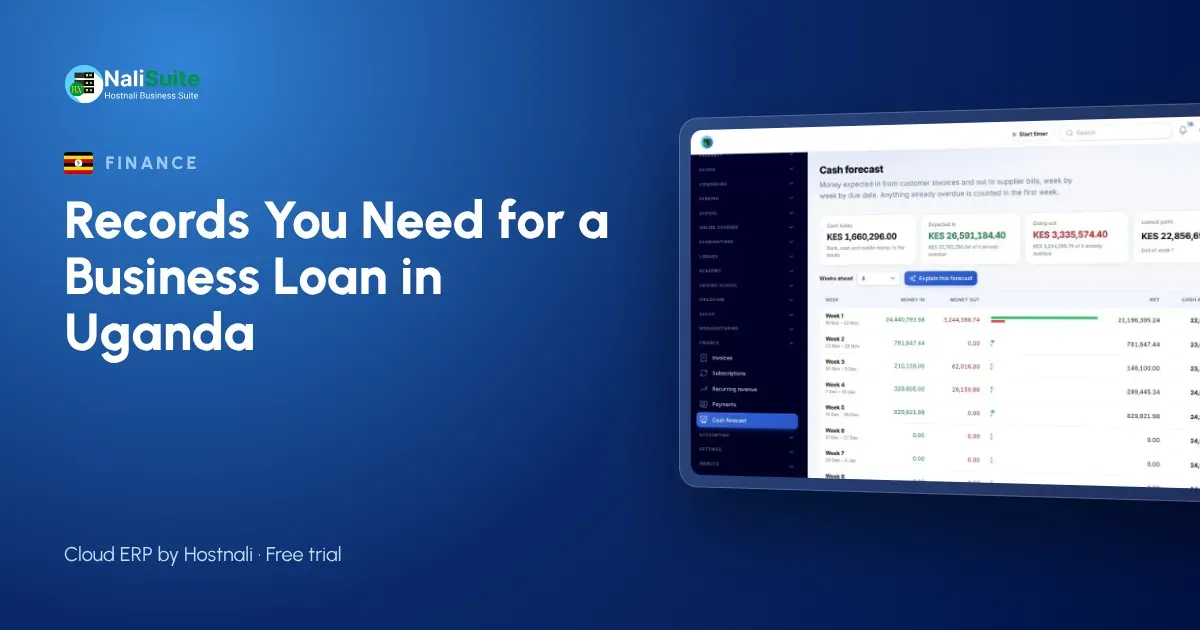
Bring: a cash flow forecast covering the loan period, month by month, including the repayments. Back it with contracts, purchase orders or a list of regular customers. Our cash flow guide for Ugandan businesses shows how to build a realistic one.
10. What happens if things go wrong?
Bring: documents for any security you can offer: land titles, vehicle logbooks, equipment invoices, or guarantor details if asked.
Putting it together: Samuel’s grain milling business
Samuel mills maize flour in Masaka and sells to wholesalers and schools. He wants to finance a larger mill.
| Question | Samuel’s answer |
|---|---|
| Registered? | URSB company documents, National IDs, trading licence |
| URA? | TIN, returns up to date, tax clearance certificate |
| Premises? | Five-year lease on the mill site |
| Money in? | Twelve months of business bank and MoMo statements |
| Profitable? | Two years of accounts, monthly management accounts |
| Owed? | Debtors list showing schools pay each term |
| Owes? | One vehicle loan, always paid on time |
| Purpose? | Quotation for the mill and installation |
| Repayment? | Forecast based on school orders and two new wholesalers |
| Security? | The new mill and his vehicle logbook |
With every question answered on paper, the loan officer’s visit to the mill was about checking the operation, not hunting for documents.
Keeping the answers ready
NaliSuite Accounting records every sale, supplier bill and payslip as it happens, so monthly profit and loss, balance sheet and cash flow statements are always ready. Invoicing keeps the aged debtors list, bank and mobile money reconciliation shows the books agree with your statements, and Documents holds registration papers, certificates and contracts in one place to share securely.
Frequently asked questions
Do lenders in Uganda accept mobile money statements?
Many consider them alongside bank statements. Ask the lender what it accepts.
Do I need audited accounts?
Smaller loans are often assessed on statements and management accounts; larger ones more often need accountant-prepared or audited accounts.
How do I get a tax clearance certificate?
It is issued by URA when your returns and payments are up to date. Check the current process with URA.
Will good records guarantee a loan?
No. They make your application easier and faster to assess.
Try NaliSuite
Have the answers ready before the lender asks. NaliSuite starts at UGX 8,500 a month with a free trial. See the plans.