 UGX
 KES - Kenya
 TZS - Tanzania
 RWF - Rwanda
 NGN - Nigeria
 ZAR - South Africa
 USD - Zimbabwe
 GHS - Ghana
 ETB - Ethiopia
 ZMW - Zambia
 USD - International

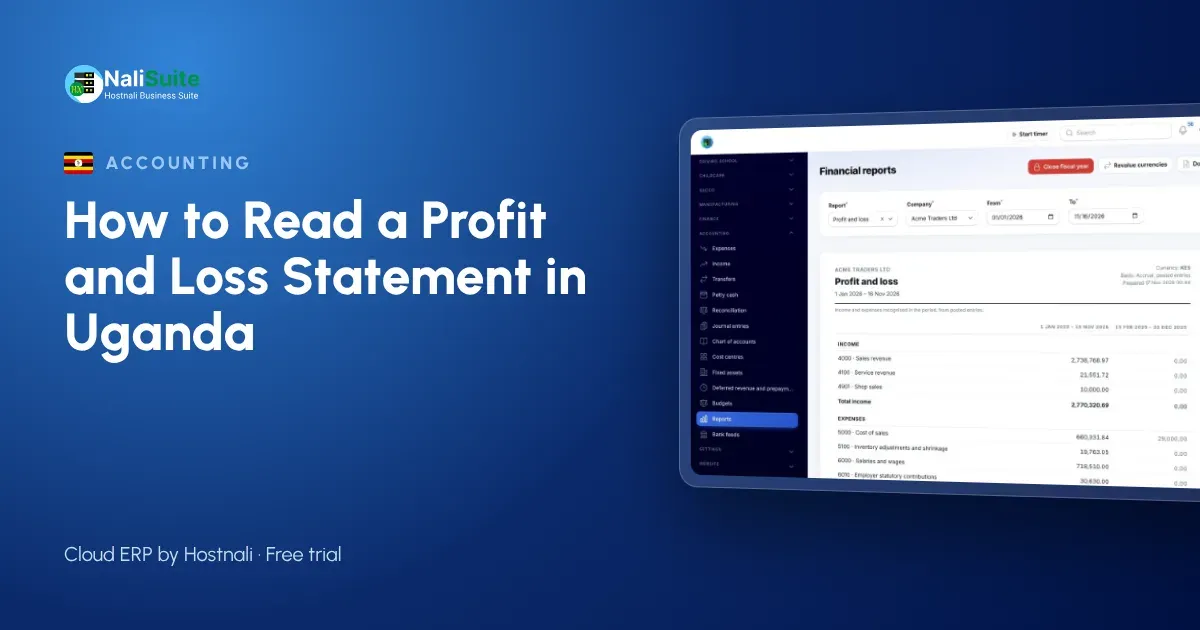
Many business owners in Uganda avoid financial statements for a simple reason: they were never shown how to read one. The report arrives from the accountant at tax time, full of terms like “cost of sales” and “accruals”, and the owner nods, signs and gets back to work. Yet the profit and loss statement (P&L) is the report that answers the questions owners ask every day. Should I raise prices? Can I afford another staff member? Is the new branch in Mbarara pulling its weight?
This guide explains the P&L as three layers of profit, shows what changes for a service business, and ends with a short monthly review routine.
Layer 1: Gross profit, the profit on what you sell
The P&L starts with revenue: all sales for the period, whether paid in cash, by MTN MoMo or Airtel Money, by bank transfer, or still owed by the customer. If you are VAT registered, VAT is excluded; it is collected on behalf of URA.
From revenue you subtract the direct cost of what you sold. For a pharmacy in Kampala, that is the cost of the medicines that left the shelves. For a printing business, it is paper, ink and outsourced finishing. The result is gross profit.
Divide gross profit by revenue to get the gross margin. This percentage is the best early-warning signal in the whole report. If it slips, you are either buying dearer, selling cheaper or losing stock.
Layer 2: Operating profit, the profit from running the business
Next come the costs of running the business: salaries, rent, power, transport, internet and airtime, mobile money and bank charges, marketing, repairs, professional fees and depreciation on equipment. Subtract them from gross profit and you have operating profit.
This is the layer that tells you whether the business model works. A shop with a strong gross margin can still lose money if rent in a prime location eats it all.
Layer 3: Net profit, what is left for the owners
Finally, interest on loans and the income tax charge are deducted. Your accountant works out the tax figure; check current rules with URA. What remains is net profit. Decide what happens to it on purpose: reinvested in stock or equipment, kept as a reserve, or paid out to the owners.
What changes for a service business
Salons, consultancies, IT support firms, clinics, driving schools and repair workshops sell time and skill more than goods. Their P&L looks a little different:
- Cost of sales may be small or absent. Some service firms show staff who deliver the work as direct cost; others show all wages as operating expenses. Pick one approach with your accountant and keep it.
- Staff cost is the biggest line. Watch it as a share of revenue every month.
- Unbilled work is lost profit. Hours worked but never invoiced never appear as revenue. Recording time against each client or job, and invoicing from it, closes the gap.
- Customer deposits are not yet revenue. A deposit for a job that has not started belongs on the balance sheet until the work is done.
An example: an IT support company in Kampala
Brian’s company provides IT support to offices under monthly contracts plus call-outs. His P&L for the quarter shows revenue up 10% but operating profit flat. The detail explains it: staff costs rose with two new technicians, and a review of timesheets shows that around a fifth of call-out hours were never invoiced because technicians forgot to log them. Raising prices is not his first move. Billing the work he already does is.
Reading tips for every business
- Compare, do not just read. Put each month next to the previous month and the same month last year.
- Check revenue against receipts. Your sales should reconcile with what arrived in your bank and mobile money accounts plus what customers still owe.
- Count stock. For shops and distributors, an end-of-month count is what makes cost of sales reliable.
- Keep owner’s spending out. Family expenses paid by the business hide the true profit. Our guide to separating business and personal money in Uganda explains how.
A monthly review routine
- Make sure every invoice, bill, payroll run and stock movement for the month is recorded.
- Reconcile the bank and mobile money accounts.
- Note gross margin, operating margin and the three biggest expenses as percentages of revenue.
- Compare with last month and last year.
- Choose one thing to change next month and write it down.
Let the books do the work
The routine is only realistic when the P&L is ready on the first day of the month. NaliSuite Accounting posts every invoice, supplier bill and payslip to the ledger as you work, so the profit and loss statement, balance sheet and cash flow statement are always current, with comparisons against earlier periods. Projects and Timesheets turns logged hours into invoices, payroll posts staff costs each month, and bank and mobile money reconciliation keeps the books in line with your statements.
Frequently asked questions
What is the difference between profit and cash?
Profit counts sales and costs when they happen. Cash counts money in and out. Late-paying customers, stock purchases and loan repayments make the two differ; our cash flow guide covers this.
Do I include VAT in my revenue?
If you are VAT registered, no. VAT you charge belongs to URA.
How often should I review the P&L?
Monthly for running the business. The annual accounts are for tax and lenders.
Can I see profit per branch or per client?
Yes, if your system tracks branches or projects separately. Then each one gets its own P&L view.
Try NaliSuite
Run your monthly review in under an hour. NaliSuite starts at UGX 8,500 a month with a free trial. See the plans.