 UGX
 KES - Kenya
 TZS - Tanzania
 RWF - Rwanda
 NGN - Nigeria
 ZAR - South Africa
 USD - Zimbabwe
 GHS - Ghana
 ETB - Ethiopia
 ZMW - Zambia
 USD - International

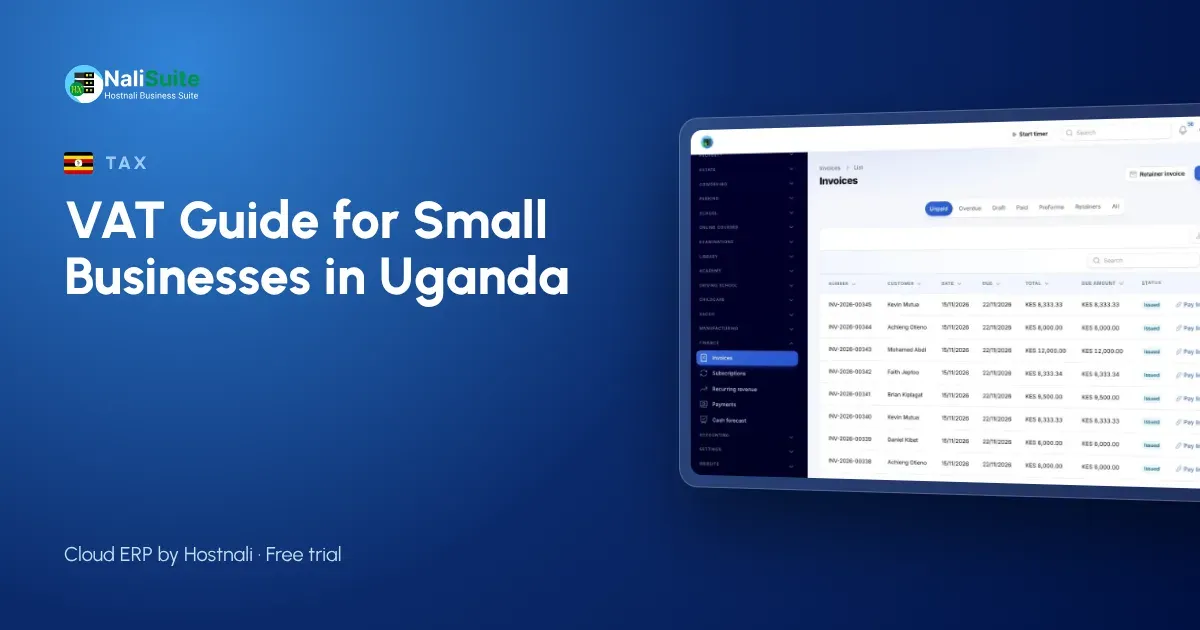
In Uganda, VAT is charged at 18%, and the Uganda Revenue Authority (URA) expects VAT-registered businesses to invoice through its electronic systems. For a Kampala wholesaler or a Jinja manufacturer, that means three things to get right: pricing, invoicing and records.
Pricing at 18%
An 18% rate adds up quickly, so be clear about whether your prices include it.
- Before VAT: UGX 500,000 × 1.18 = UGX 590,000, so the VAT is UGX 90,000.
- Including VAT: UGX 118,000 ÷ 1.18 = UGX 100,000 net and UGX 18,000 VAT.
Put both in your head once and you’ll never undercharge. The VAT calculator is there for the less round numbers.
EFRIS and your invoices
URA uses EFRIS for electronic invoicing and receipting. Whether and how you must use it depends on your registration, so check with URA. Separately from EFRIS, your invoices should always carry your TIN, a sequence number, the date, the items and the VAT shown on its own line. NaliSuite Invoicing does the numbering and VAT for you.
Input tax: buy from suppliers who invoice
VAT on your purchases reduces the VAT you pay, but only with valid supplier invoices. In markets where much trade is informal, this is worth a conversation with your suppliers.
Getting paid and matching it
Ugandan customers often pay by MTN Mobile Money or Airtel Money. If those payments land without a reference, matching them to invoices takes hours. NaliSuite’s mobile money payments put a pay link on each invoice, so the payment and the VAT invoice meet automatically.
Your VAT return
The return compares output VAT on sales with input VAT on purchases. Keep both in NaliSuite Accounting through the month and use the VAT report to file with URA. Confirm the filing deadline with URA.
Three mistakes to avoid
- Quoting a lump sum to a business customer without saying whether VAT is in it.
- Losing supplier invoices, then paying VAT you could have claimed.
- Treating mobile money receipts as “other income” instead of linking them to invoices.
A worked month for a Kampala wholesaler
A sample wholesaler in Kikuubo sells rice, sugar and cooking oil to retailers. Some basic foods may be exempt or zero-rated, while other goods carry 18%, so the wholesaler sets the tax per product. Each month, the VAT report separates taxable sales from exempt ones, and the input VAT on transport, rent and packaging is claimed from valid supplier invoices.
Most retailers pay by Mobile Money. Because they pay through the invoice’s link, the payments arrive already matched to invoices, and the wholesaler’s assistant no longer spends Friday afternoons reading SMS messages.
Exempt, zero-rated and standard
These three words mean different things. Standard-rated sales carry 18%. Zero-rated sales carry VAT at 0% but still count as taxable, so you can usually claim input VAT on related purchases. Exempt sales carry no VAT and you generally can’t claim related input VAT. Ask URA or your accountant which applies to each of your products.
Second example: services billed monthly
A sample Kampala cleaning company bills offices a fixed monthly fee of UGX 1,000,000 before VAT. Each month’s invoice adds UGX 180,000 of VAT, for UGX 1,180,000 in total. Using NaliSuite Subscriptions, the invoice goes out on the same day each month with VAT already calculated, and customers pay by Mobile Money from the link.
Records URA may ask for
Keep sales invoices, supplier invoices, credit notes, Mobile Money and bank statements and your return workings for each month. When URA asks about a figure, you should be able to show the invoices behind it. With everything recorded in NaliSuite as it happens, the trail from the return to each document is a few clicks, not a box of receipts.
Price changes and old quotations
If your supplier raises prices or a tax changes, check open quotations before customers accept them. NaliSuite quotations carry the tax at the time they’re issued, so update and re-send any that are out of date.
When to ask an adviser
Have an accountant check your product tax settings when you register and when URA changes a rule.
Frequently asked questions
What is the VAT rate in Uganda?
The standard rate used here is 18%. Some goods and services are exempt or zero-rated.
Does NaliSuite connect to EFRIS?
NaliSuite prepares invoices with VAT per line. Check with URA how EFRIS applies to your business.
Can I set different taxes for different products?
Yes. Each product carries its own tax, used on every invoice and receipt.
What if a customer asks for a “VAT-free” price?
You can’t drop VAT on a taxable sale. You can offer a discount on the price before VAT if you choose to.
Can my accountant see the VAT report?
Yes. Invite them as a user and they see the same figures you do.
Should my quotations include VAT?
Show it, so the customer sees the full price.
Try NaliSuite
18% VAT worked out per line, mobile money matched to invoices and a VAT report each month, from UGX 8,500 a month. Plans.