 UGX
 KES - Kenya
 TZS - Tanzania
 RWF - Rwanda
 NGN - Nigeria
 ZAR - South Africa
 USD - Zimbabwe
 GHS - Ghana
 ETB - Ethiopia
 ZMW - Zambia
 USD - International


Plenty of Ugandan businesses already bill on a schedule: landlords in Kampala and Entebbe, schools in Wakiso, gyms in Ntinda, waste collectors in Mukono and IT firms serving offices across the city. Most track it in a spreadsheet and send reminders by hand.
This guide follows an example landlord as she moves from that spreadsheet to automatic recurring billing, step by step. The same steps apply to any business that bills the same customers every period.
Where she started
Grace owns three apartment blocks in Kampala with 36 units. Her spreadsheet had a row for each tenant and a column for each month. At the start of the month, she sent each tenant a WhatsApp message. When MTN MoMo or Airtel Money payments came in, she typed them into the sheet.
It worked, mostly. But:
- she spent the first ten days of each month sending messages and checking payments;
- tenants who paid part of the rent were hard to track;
- when she raised rent on one block, two tenants were missed for three months;
- she could never answer “how much is outstanding?” without a long evening.
Step 1: Clean up the list
Before moving anything, Grace checked every row: tenant name, phone number, unit, monthly rent, deposit held and the date the tenancy started. She found two tenants who had moved out and one unit with the wrong rent.
Tip: moving dirty data into new software only moves the problem. Fix the list first.
Step 2: Create plans
Grace had three kinds of unit: one-bedroom, two-bedroom and shop units on the ground floor. She created one plan for each, with the monthly rent. Service charges were a separate plan added to every residential tenant.
In NaliSuite Subscriptions, plans are what you sell repeatedly. When she raises the rent for two-bedroom units next year, she will change one plan instead of 14 rows.
Step 3: Add each tenant as a subscription
For each tenant, Grace created a subscription: the tenant, their plan or plans, monthly billing and the start date. For tenants with a fixed lease end, she added an end date.
Step 4: Decide billing and due dates
She chose to bill everyone on the 1st, with payment due by the 5th. Reminders would go out on the 3rd, on the 5th and on the 12th. NaliSuite Invoicing sends these automatically by email or WhatsApp.
Step 5: Turn on pay links
Each invoice now carries a link to pay by MTN MoMo, Airtel Money or card. When a tenant pays through the link, the payment is matched to their invoice straight away. The mobile money payments page explains how. Tenants who pay to her merchant number without the link are matched when she imports the statement in NaliSuite Accounting.
Step 6: Bring in old balances
Three tenants owed rent from earlier months. Grace entered their opening balances so the first statements were correct. Tenants could see their full balance from day one.
Step 7: Give tenants the portal
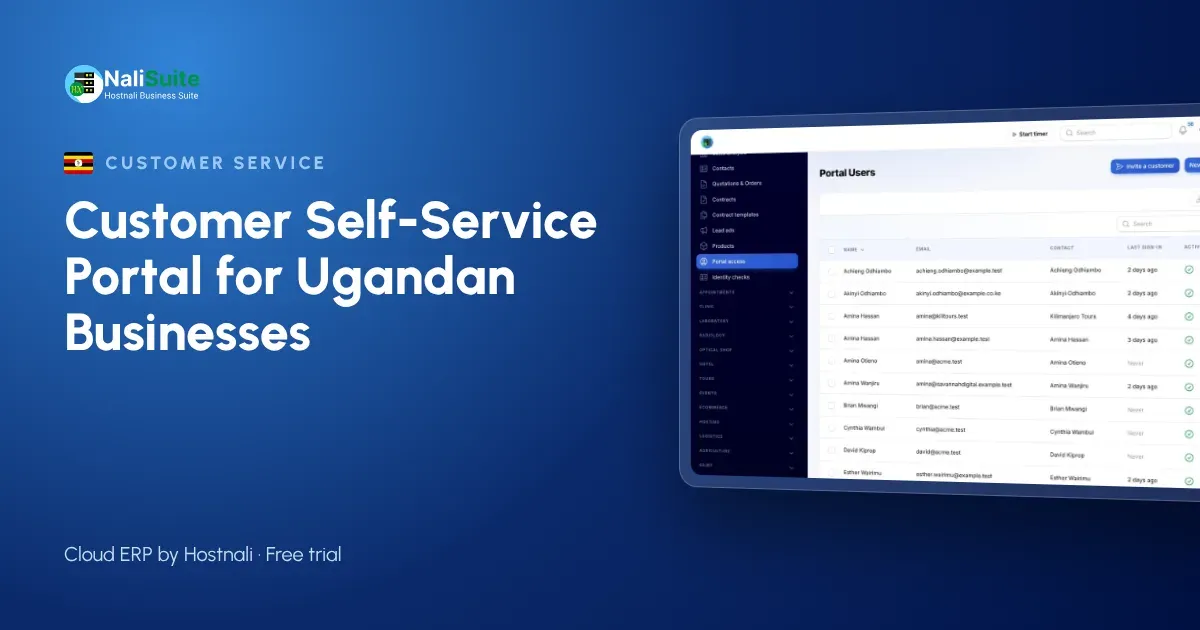
Through the customer portal, tenants can see every invoice and payment and pay what is due. Grace no longer sends statements on request.
What changed after two months
- Invoices went out on the 1st without her touching them.
- Most tenants paid through the link within the first week.
- Part payments were tracked automatically against each invoice.
- She could see total outstanding rent, and which tenants owed it, in one screen.
- Her first ten days of every month were free again.
Adapting this to your business
| Business | Plans might be | Period |
|---|---|---|
| School | Tuition per class, transport, meals | Termly |
| Gym | Standard, off-peak, student | Monthly or yearly |
| Waste collection | Household, shop, office | Monthly |
| IT support | Basic, standard, premium | Monthly |
The steps are the same: clean the list, create plans, add subscriptions, set dates and reminders, turn on pay links and give customers the portal.
Tax
If your business is VAT-registered, set VAT at 18% on the plans that attract it. Residential rent and some education services are treated differently from commercial rent or other services, so ask your accountant which of your plans carry VAT. Check URA’s current requirements for electronic invoices and receipts.
Watching the business
NaliSuite’s subscription dashboard shows recurring revenue, new and lost subscribers and churn. For a landlord, churn is tenants leaving; for a gym, members cancelling. Either way, a rise is a signal to act.
Frequently asked questions
How long does it take to move from a spreadsheet?
For a few dozen customers, an afternoon to clean the list and set up plans, plus checking the first month’s invoices.
Can tenants pay part of the rent?
Yes. Each payment is recorded against the invoice and the balance stays open.
What if a customer leaves mid-month?
End or change the subscription, and the amount for the days used is worked out for you.
Do I need a separate MoMo number for the business?
It is strongly recommended. A business merchant number keeps payments separate from personal money.
Try NaliSuite
NaliSuite moves your recurring billing out of the spreadsheet: automatic invoices, MoMo pay links and a portal for customers. Plans start at UGX 8,500 a month with a free trial; see the plans or read about NaliSuite.