 UGX
 KES - Kenya
 TZS - Tanzania
 RWF - Rwanda
 NGN - Nigeria
 ZAR - South Africa
 USD - Zimbabwe
 GHS - Ghana
 ETB - Ethiopia
 ZMW - Zambia
 USD - International

When we talk to owners of small Ugandan firms about projects, the same questions come up again and again. How do I stop things falling through the cracks? Do my staff really need timesheets? How do I know whether a job made money? This guide answers them one by one, using a training consultancy in Kampala as the running example.
Meet the example business
A consultancy in Ntinda, Kampala, has ten staff. It designs and delivers training for companies and NGOs: a customer service course for a bank branch network, a monitoring and evaluation workshop for an NGO in Gulu, and a leadership programme for a manufacturer in Jinja. Each one is a project with preparation, delivery days, reports and payments.
“How do I stop things falling through the cracks?”
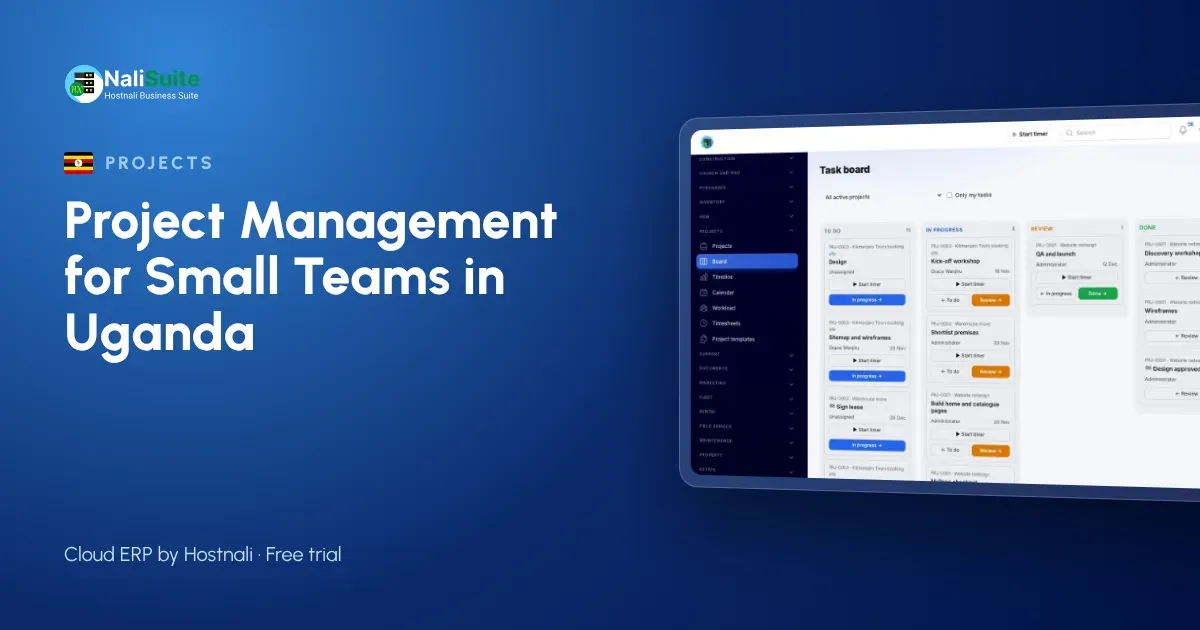
Give every piece of work one home and one owner. In NaliSuite Projects, each programme is a project and each piece of work is a task with an assignee, a due date and a checklist.
For the Gulu workshop, the tasks look like this:
- Agree objectives with the NGO (lead consultant)
- Prepare materials and handouts (training officer)
- Book venue and travel (administrator)
- Deliver the workshop (lead consultant and co-facilitator)
- Send the evaluation report (lead consultant)
When the administrator opens the board on Monday, the travel booking is right there with a date next to it. Nothing depends on someone remembering a voice note.
“My team hates admin. Will they actually use it?”
They will if it saves them questions. The board works like sticky notes on a wall: To do, In progress, Waiting for client, Done. People move their own cards, and nobody has to ask “where are we with Jinja?” in the staff group.
Keep the first version simple. Add more structure only when you need it.
“Do my staff really need timesheets?”
If you ever bill by the day or the hour, or you want to know your real costs, yes. Staff log time on the task from a timer or a timesheet, and a manager approves it each week.
Approved time does two things for the Kampala consultancy:
- Extra coaching sessions requested by the manufacturer are billed at the agreed rate rather than given away.
- The owner can see that report writing takes far longer than the quotes allowed for.
“How should I bill a project?”
Match the billing to the contract. Projects supports fixed prices, milestones and billing from approved time, and you can mix them. The bank course might be a fixed fee split into a deposit and a balance; the NGO workshop is paid after the report; the leadership programme is billed per session delivered.
Invoices go out from NaliSuite Invoicing with a pay option for MTN MoMo, Airtel Money or card. Payments made through mobile money are recorded against the right invoice. Keep your invoices in line with what URA requires of your business.
“How do I avoid overloading my best people?”
Use the workload view. It shows who is over or under booked across all projects. At the consultancy it revealed that the lead consultant was delivering in Gulu and Jinja in the same week while also writing two reports. One report moved to a colleague, and both workshops ran on time.
The timeline and calendar views help you see overlaps before you promise dates to a new client.
“Did that job make money?”
Profitability compares what you billed with the cost of the time logged. After a few months you will have real numbers instead of a feeling. For the consultancy, workshops outside Kampala turned out to be the least profitable because of travel days, so the next quotes included them.
“Can the client see progress without calling me?”
Yes. Projects can be shown in the customer portal. The NGO in Gulu can see that the materials are ready, download the agenda and pay the invoice in one place. Shared documents, such as attendance lists or signed agreements, can be stored and signed online in NaliSuite Documents.
Participant lists and staff details are personal data under Uganda’s Data Protection and Privacy Act, 2019, so give clients access only to their own records and staff access only to the projects they work on.
“How do I get started?”
Pick your busiest current project and move it in first. Add tasks, owners and dates, ask the team to log time for two weeks, and hold a short review every Monday. When the next similar job comes in, save the first one as a template.
Working with partners upcountry
Workshops in Gulu, Mbarara or Mbale often rely on a local partner for the venue, transport or participants. Add each partner’s tasks to the project with clear dates, and share the relevant documents with them, so everyone works from the same plan. A short note on the task after every call stops misunderstandings that used to surface only on the day.
Frequently asked questions
Can facilitators update tasks from the venue?
Yes. NaliSuite runs in a phone browser, so tasks and time can be updated wherever there is a connection.
Can I mix fixed fees and hourly billing in one project?
Yes. Use milestones for the fixed parts and approved time for extra work.
Can clients see each other’s projects?
No. Each portal user sees only their own organisation’s records.
Try NaliSuite
Every NaliSuite plan includes Projects, Invoicing, Documents and the customer portal, from UGX 8,500 a month. Check the plans and start a free trial with your busiest project.