 UGX
 KES - Kenya
 TZS - Tanzania
 RWF - Rwanda
 NGN - Nigeria
 ZAR - South Africa
 USD - Zimbabwe
 GHS - Ghana
 ETB - Ethiopia
 ZMW - Zambia
 USD - International

Ask ten Kampala suppliers for a quote on the same job and you will get ten very different documents: a handwritten note, a WhatsApp voice message, a spreadsheet, and perhaps two or three proper quotations. The proper ones are usually the ones that win, even when they are not the cheapest.
Here is what goes into a quotation that Ugandan customers, from households to NGOs and government buyers, can trust and act on.
What a quotation is for
A quotation does three jobs at once:
- It tells the customer exactly what they will get.
- It fixes the price for a limited time.
- It gives them what they need to approve and pay: totals, tax, terms and payment details.
Procurement officers at companies and NGOs often need to compare three quotes. A clear one makes their job easy, which helps you.
The building blocks
Header
Your business name, address, phone, email and TIN. Many corporate and NGO buyers will not process a quote without a TIN. Add your VAT registration if you have one.
Customer block
The customer’s name, organisation and contact person. For organisations, include their TIN if they want it on the invoice.
Reference and validity
A quote number, the date and how long the price holds. With fuel and imported goods prices moving, many Ugandan suppliers use 14 days. Say so clearly: “Prices valid for 14 days from the date above.”
Scope of work
Write the scope as a short paragraph. For example: “Supply of 20 office chairs, model as per attached photo, delivered to the client’s office in Ntinda. Delivery within 5 working days of order.” Mention exclusions: “Assembly not included.”
Items and prices
List each item with quantity, unit price and total. For services, use hours, days or fixed fees. Keep descriptions short but specific.
Tax
If your business is registered for VAT, show VAT at 18% on a separate line and the total including VAT. Do not charge VAT if you are not registered. Check whether URA’s e-invoicing or e-receipting rules apply to the invoice that will follow the quote.
Payment terms
Say when and how: deposit, balance, and the accounts to pay into. For example: “60% on order, 40% on delivery. MTN MoMo merchant code [number] or Airtel Money [number], or bank transfer to [account].”
Conditions and acceptance
Delivery time, warranty and what happens if the order changes. End with how the customer accepts: signing, a purchase order or an online link.
A template you can copy
[Business name] · TIN [number] · [Phone] · [Email]
QUOTATION No. Q-0157          Date: 10 November
Valid until: 24 November

To: [Customer name], [Organisation], [Town]

Scope: Supply of 20 office chairs delivered to Ntinda within 5 working days.
Excludes assembly.

Item                Qty   Unit price   Total
Office chair         20   ...          ...
Delivery              1   ...          ...
                          Subtotal     ...
                          VAT 18%      ...
                          Total        ...

Payment: 60% on order, 40% on delivery, by MoMo, Airtel Money or bank.
Warranty: 12 months on manufacturing defects.
Accepted by: ____________  Date: ______
Making quotations quicker
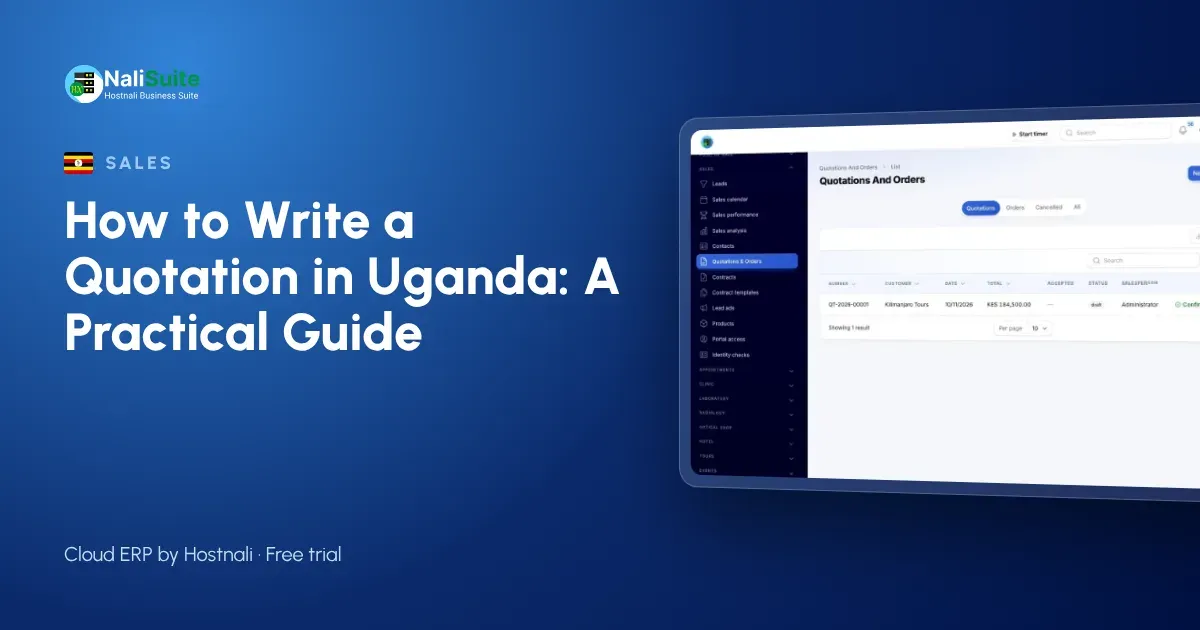
Writing every quote by hand takes time and invites mistakes. NaliSuite Sales and Quotations fills in your products, prices and VAT from your price list, lets you add optional lines and discounts, and sends a branded PDF by email or WhatsApp. The customer accepts through a secure link and you are notified at once.
When a quote is accepted, it becomes a sales order that reserves the stock in inventory and then an invoice, so nothing is retyped. Invoices from NaliSuite Invoicing include a link to pay by MTN MoMo, Airtel Money or card; the mobile money payments feature explains how.
Quoting for NGOs and companies
- Match their format. Some organisations send a request form; answer every line on it.
- Quote what was asked. Offer an alternative separately, not instead.
- Send on time. Late quotes are often ignored.
- Include supporting documents they ask for, such as a trading licence or TIN certificate.
Following up
After sending, wait two or three days and then call or message. Ask whether the quote is clear and whether a decision date has been set. Many jobs are lost simply because the supplier never asked.
Keep track of every quote and its status. A simple board in the CRM app shows which quotes are waiting, won or lost, and why.
Pricing in Ugandan shillings when costs are imported
Many goods sold in Uganda are imported, so supplier prices follow the exchange rate. If that applies to you, keep your validity short, note the date you checked your costs and say on the quote that prices may be revised after the validity date. For large orders, ask for a deposit that lets you buy the goods at once. That protects your margin without surprising the customer later.
Frequently asked questions
What is the difference between a quotation and a proforma invoice?
A quotation is an offer for the customer to accept. A proforma invoice is usually sent after agreement, so the customer can arrange payment before the final invoice.
How long should a quote be valid in Uganda?
There is no fixed rule. Fourteen to thirty days is common; shorter if your costs change quickly.
Should I include my TIN on a quotation?
Yes. Corporate, NGO and government buyers often need it, and it shows the business is registered.
Can customers accept a quote from their phone?
Yes, if you send it as a link. NaliSuite records the acceptance and notifies you.
Try NaliSuite
NaliSuite helps Ugandan businesses send quotes customers accept online, then invoice and collect by MoMo from the same record. Plans start at UGX 8,500 a month with a free trial; see the plans or read about NaliSuite.