 UGX
 KES - Kenya
 TZS - Tanzania
 RWF - Rwanda
 NGN - Nigeria
 ZAR - South Africa
 USD - Zimbabwe
 GHS - Ghana
 ETB - Ethiopia
 ZMW - Zambia
 USD - International

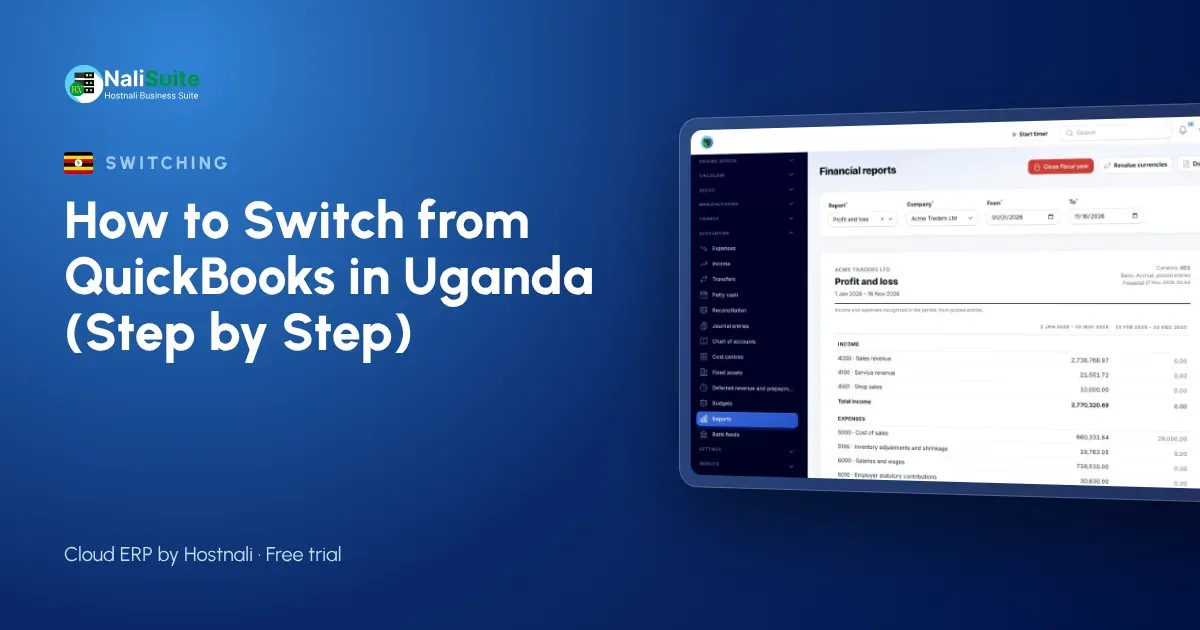
Ugandan businesses commonly run QuickBooks or Tally beside EFRIS, a POS and a payroll spreadsheet. A single system is easier to run, but you need a clean cut-over date and good opening balances.
What you gain
QuickBooks, Xero and Sage keep your books. NaliSuite keeps your books and runs the rest of the business: CRM, quotations, accounting, invoicing with MTN MoMo or Airtel Money payments, stock, the till, HR and payroll, on one login. See the full comparison on the switch from QuickBooks page.
An example from Uganda
A dairy processor in Mbarara used Tally for accounts and Excel for milk deliveries from farmers. Paying farmers by MTN MoMo meant building payment lists by hand every fortnight. After switching, deliveries, deductions and payouts are worked out in the system, and the payout file is ready in minutes.
Questions to answer before you start
- What is your go-live date, and is your accountant happy with it?
- Which reports does your accountant need from you each month in Uganda?
- Will your accountant work in NaliSuite, or should you keep a QuickBooks or Xero sync?
- How many branches, tills and warehouses need setting up?
- Are there old invoices to write off before you import?
- Does payroll move now, or after the ledger?
Step 1: export what you need
From QuickBooks, Xero, Sage or Excel, export:
- customers and suppliers, with contact details and tax numbers;
- items and services, with prices and, for stock items, quantities on hand;
- the chart of accounts;
- a trial balance at your go-live date;
- open invoices and bills (what customers owe you and what you owe suppliers);
- employees, if payroll moves too.
Putting the data in
Imports in NaliSuite are sheet uploads with a column-matching screen. Start with your accounts, contacts and items, which change rarely. Then enter the opening trial balance and the open invoices and bills, and finally the stock count. Check each step against the old system before moving on.
Fix the spreadsheet, not the new system
Export everything to Excel, sort each list and look for duplicates, blanks and old records. Fix them in the sheet, save, and only then import. A clean start makes reports trustworthy from the first month.
Uganda-specific details
Ugandan businesses should import TINs for customers and suppliers, check how their invoices relate to EFRIS with their accountant, and connect MTN MoMo or Airtel Money through their own accounts. Tally users can use the Tally and Odoo migration add-on.
Step 3: run both for a month
For one month, keep entering in both systems, or at least compare the totals: sales, debtors, creditors and bank balances. When they match, stop using the old one. Most differences come from starting balances or a few invoices entered in one system only, and they are quick to find with the two side by side.
What it costs
NaliSuite plans start at UGX 8,500 a month, with all 17 built-in apps on every plan, so you are not paying separately for accounting, invoicing, stock and payroll. Compare that with what you spend today on licences and add-ons, and on the hours spent re-keying data between them.
Coming from Tally or Odoo
The Tally and Odoo migration add-on brings ledgers, items and parties across from Tally and Odoo, so you do not have to rebuild them by hand.
Moving the rest of the business
Once the ledger are across, bring the other sheets in one at a time: stock counts into Inventory, customer follow-ups into CRM, and employees into HR. If payroll moves too, add employees with their contracts and statutory numbers; statutory payroll works out PAYE and NSSF from the first pay run.
Mistakes to avoid when switching
- No go-live date. Without one, transactions end up in both systems or neither.
- Importing all history. Bring balances and open items; keep the old system as an archive.
- Forgetting stock values. Opening stock in the ledger must match the stock count.
- Switching at the busiest time of year. Pick a quieter month.
- Not telling employees. Show the team the new till and invoicing screens before go-live.
Your first month after the switch
In the first month after the switch in Uganda: send every new invoice from NaliSuite with its pay link; connect MTN MoMo or Airtel Money payments through your own accounts; reconcile the bank weekly; count stock once at month-end and compare; and run payroll in NaliSuite if it moved too. By the end of the month, your team should not need the old system for anything but history.
Keeping a sync instead of a hard switch
You do not have to switch everything at once. With the QuickBooks and Xero Sync add-on, NaliSuite handles sales, stock and payroll while QuickBooks or Xero stays your accountant’s ledger. Many companies run like this for a year before moving fully.
Frequently asked questions
Does NaliSuite replace EFRIS?
No. Check with URA and your accountant how your invoices relate to EFRIS; NaliSuite keeps your invoicing and books in one place.
Can we pay farmers by mobile money?
Yes. Payout files for MTN MoMo and Airtel Money are produced from the figures in the system.
Can your team help with the import?
Yes. Our team can help with the first import from your spreadsheets.
Try NaliSuite
Every NaliSuite plan includes accounting, invoicing, stock, POS, HR and payroll, from UGX 8,500 a month. Start a free trial, import your lists and see your own numbers in it, or compare the plans.