 UGX
 KES - Kenya
 TZS - Tanzania
 RWF - Rwanda
 NGN - Nigeria
 ZAR - South Africa
 USD - Zimbabwe
 GHS - Ghana
 ETB - Ethiopia
 ZMW - Zambia
 USD - International

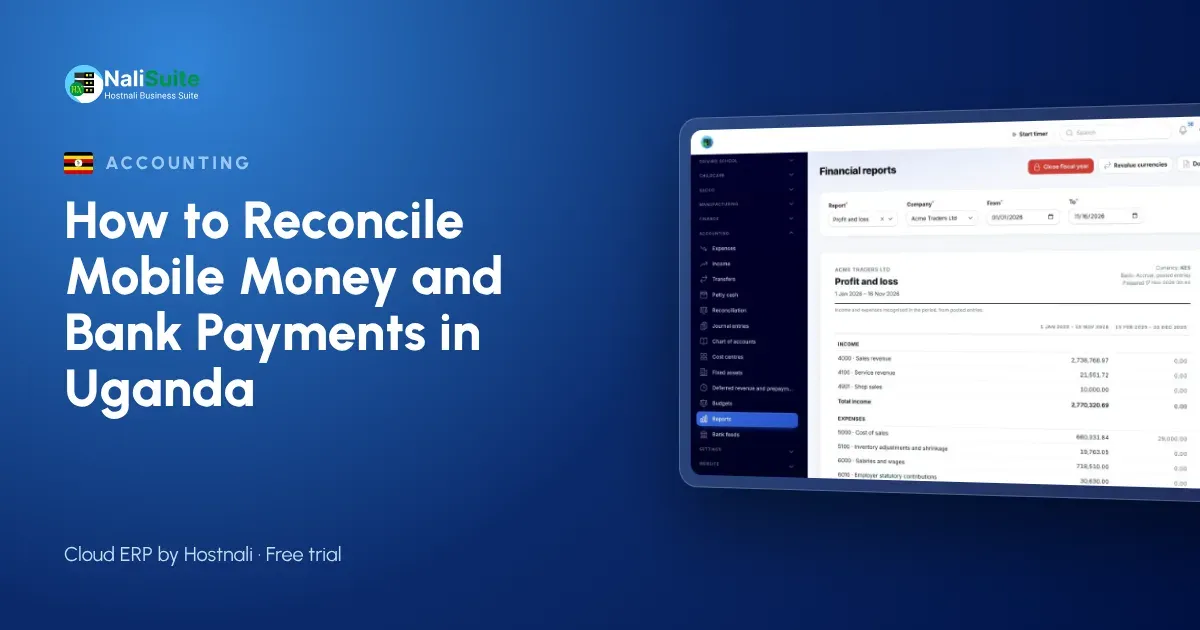
For a hardware dealer in Mbarara, a busy Saturday can mean fifty MTN MoMo and Airtel Money payments, a few bank transfers from contractors and a pile of cash. On Monday, the question is simple and surprisingly hard: which of those payments settled which invoices? That is what payment reconciliation answers.
The Ugandan payment mix
Mobile money is the default for many customers, and merchant codes make it easy to pay. But mobile money references are short, customers often pay from someone else’s line, and some payments arrive in instalments. Bank transfers from companies carry better narrations but may be reduced by withholding deductions. Your routine has to cope with both.
Weekly checklist
- Export the MTN MoMo, Airtel Money and bank statements for the same dates.
- Match payments that quote an invoice number first.
- For the rest, match by amount and payer, confirming with a quick call or message when unsure.
- Record instalments against the same invoice so the balance stays visible.
- Post network charges and bank fees as expenses.
- Record sweeps from wallets to the bank as transfers.
- Check that every wallet and account balance agrees with its statement.
Once a week is enough for most businesses. Shops with heavy mobile money traffic often do a quick daily check of the till wallet.
A worked example
A customer owes for two invoices, one larger and one smaller. They send a single MoMo payment that covers both and a little more. Record it against both invoices and keep the extra as credit on their account, to use against the next invoice. Their statement then shows exactly what happened.
When the numbers will not agree
| Symptom | Check |
|---|---|
| Book balance higher than wallet | A payment recorded twice, or a sweep counted as income |
| Book balance lower than wallet | A payment not yet recorded |
| Invoice open, customer says paid | Search by amount and date across all wallets |
| Small regular differences | Network charges not recorded |
Keeping URA records tidy
Reconciled receipts make it easy to support your declarations to URA, and your sales records stay consistent with the money you actually received. If you use EFRIS for invoicing, check the current requirements with URA.
Doing it in NaliSuite
NaliSuite Accounting imports wallet and bank statements and suggests the invoice each line pays. Invoices sent with a mobile money pay link are marked paid as soon as the money arrives. The bank reconciliation feature handles instalments and combined payments.
Using reconciliation to spot staff errors
Reconciliation is also an honest check on cash handling. If the till shows more sales than the money that reached the wallets and the bank, someone may have recorded a sale that was never paid, or cash was not handed over. Compare each cashier’s till session with the receipts for that session. Patterns show quickly: a gap on the same shift every week deserves a quiet conversation. Most differences turn out to be mistakes, not theft, but you only find them by looking.
A second example: a Jinja hotel
A lakeside hotel in Jinja takes booking deposits by MTN MoMo and bank transfer, room charges at check-out by card or mobile money, and corporate conference bookings on account. The accounts assistant reconciles each channel separately every Tuesday. Deposits are matched to bookings by the booking number. Conference invoices are matched to the organisation’s transfer, which often arrives net of a deduction recorded against the invoice. Refunds for cancelled bookings are matched to the original deposit, so both appear together on the guest’s account.
Mistakes Ugandan businesses can avoid
- Merchant code payments not recorded per customer. Match them to invoices, not just to a daily total, when they are for credit customers.
- One wallet shared by several branches. Give each branch its own wallet or reference so takings can be traced.
- Forgetting reversed transactions. Record reversals so the wallet balance agrees.
- Leaving unidentified payments for months. Follow them up within the week.
Who should reconcile
Where possible, separate the person who receives payments from the person who reconciles them. A monthly review by the owner keeps everyone careful.
Frequently asked questions
Should I keep separate records for each wallet?
Yes. Treat each wallet like a bank account in your books and reconcile it separately.
How do I record an overpayment?
Keep the extra as customer credit and apply it to their next invoice, or refund it.
Can staff reconcile, or only the owner?
Anyone with the right access can reconcile; the owner or accountant reviews the result.
Can each branch have its own mobile money wallet?
Yes, and it makes reconciliation much easier because each branch’s takings can be traced separately.
How do I match a refund?
Record it against the original receipt or invoice so the customer’s account shows both.
How do I match a payment sent from a relative’s phone?
Confirm with the customer, then record it against their invoice with a note of the sender.
Try NaliSuite
NaliSuite starts from UGX 8,500 a month. See the plans.