 UGX
 KES - Kenya
 TZS - Tanzania
 RWF - Rwanda
 NGN - Nigeria
 ZAR - South Africa
 USD - Zimbabwe
 GHS - Ghana
 ETB - Ethiopia
 ZMW - Zambia
 USD - International

Walk down Kikuubo and you will see thousands of traders selling the same goods at slightly different prices. The ones who grow are rarely the cheapest. They are the ones who know their numbers well enough to price confidently, give the right discount to the right buyer and never sell at a loss by accident.
Here is a simple, repeatable method for pricing products in a Ugandan shop, wholesale business or small factory.
1. List every cost behind a product
Take one product and write down everything you paid to have it ready for a customer:
- what you paid the supplier or manufacturer,
- boda boda or lorry transport from the supplier,
- loading and offloading,
- packaging and labels,
- the share of goods that get damaged, expire or go missing,
- any charges you pay to receive MTN MoMo, Airtel Money or card payments.
Total these for a batch and divide by the number of units. This is your direct cost per unit.
2. Add your share of overheads
Your shop rent, staff pay, electricity, security, data bundles and your own salary are paid from sales. Add them up for a month. Estimate how many units you sell in a month across all products and divide. Add that figure to each unit’s direct cost.
The result is your full cost – the lowest price you can sell at without losing money.
3. Pick a target margin for each product group
Margins should reflect how fast products move and how much effort they take:
| Group | Example | Target margin |
|---|---|---|
| Fast movers | Soap, sugar, soda | Low, earned on volume |
| Regular stock | Household goods | Medium |
| Slow or specialist | Electronics, spare parts | Higher |
The margin is worked out on the selling price, so the formula is: price = full cost ÷ (1 − margin). A 20% margin means dividing by 0.8.
4. Put VAT in the right place
If you are registered for VAT, the standard rate in Uganda is 18%, and it is collected for URA. Decide whether your prices are shown with VAT included (normal in retail) or before VAT (normal for business clients), and calculate your margin on the amount before VAT. The free VAT calculator makes the sum quick when you check a supplier’s quotation or set a shelf price.
5. Compare with the market
Only now look at competitors. If your price is far above theirs, ask why. Perhaps your transport cost is high and a closer supplier would help, or perhaps you offer delivery, credit or a warranty that justifies the difference. If your price is far below theirs, you may be leaving money on the table.
6. Write the price lists down
Most pricing mistakes in Ugandan businesses happen at the counter or on WhatsApp, when someone has to decide a price on the spot. Fix that with written price lists:
- retail prices,
- wholesale prices above a minimum quantity,
- prices for institutions such as schools, hospitals and NGOs, usually by quotation.
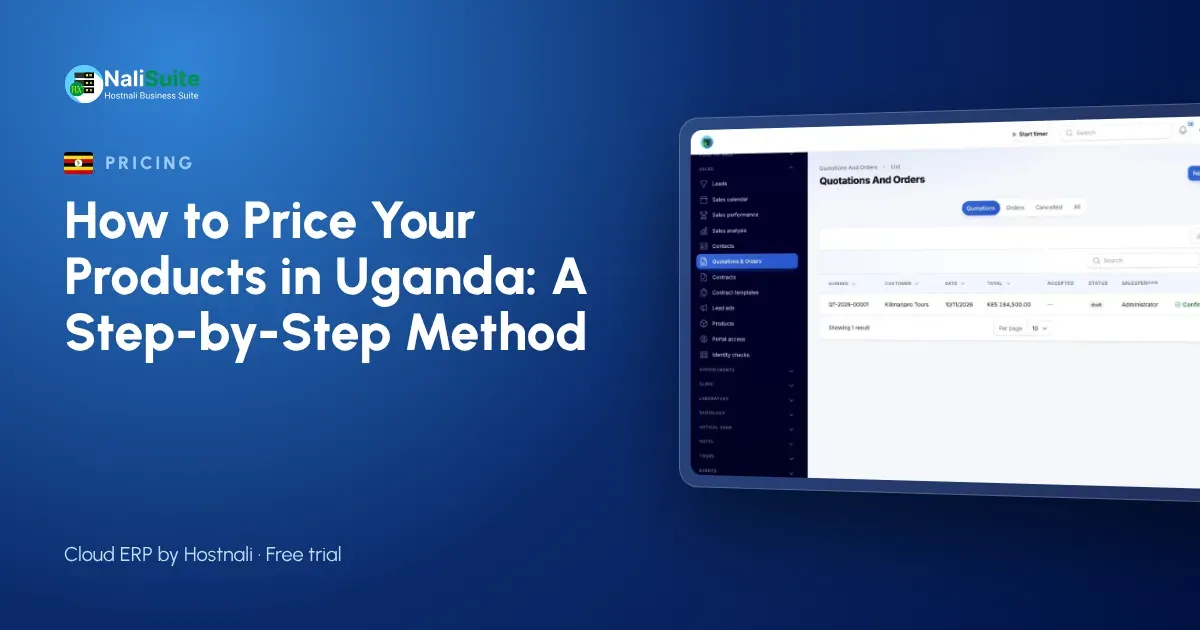
NaliSuite’s sales app keeps price lists by customer group or quantity and builds quotations from them, and the point of sale applies the same prices at the till.
A worked example
A wholesaler in Kampala sells cartons of a sample cooking oil. Using plain example numbers:
- Supplier price: 92,000 per carton.
- Transport and offloading: 2,500.
- Losses and damage: 500.
- Share of overheads: 3,000.
- Full cost: 98,000.
For a 6% wholesale margin: 98,000 ÷ 0.94 ≈ 104,300. The wholesaler sells to shops at 104,500 per carton for orders of ten or more, and at 107,000 for single cartons, where handling per carton is higher.
7. Review often
Fuel prices, supplier price lists and the exchange rate for imported goods all move. Check margins every month and every time a big cost changes. In NaliSuite, inventory keeps the landed cost of each product, including freight and duty, and accounting shows gross margin by product, so you can see which prices need updating before they cost you.
Pricing for schools, NGOs and other institutions
Many Ugandan suppliers earn a big share of their income from schools, hospitals, NGOs and government offices. These buyers usually ask for a formal quotation, compare several suppliers and pay weeks after delivery. Price that delay in: money tied up for a month or two costs you, so an institutional price can reasonably sit a little above your wholesale price. Always state on the quotation how long the price is valid, whether VAT is included, the delivery terms and when payment is due. A clear, professional quotation often wins against a slightly cheaper one that leaves questions unanswered.
Frequently asked questions
Why do wholesalers work on such small margins?
They sell large volumes, so a small margin on many cartons adds up. A small shop selling fewer units usually needs a higher margin.
How do I stop staff giving unauthorised discounts?
Set price lists and a maximum discount in your system. Anything above it needs your approval.
Should prices end in round numbers?
For cash sales, round prices make change easier. For mobile money and invoices, exact prices are fine.
Try NaliSuite
NaliSuite keeps costs, price lists, quotations and till prices together, so every price is based on real numbers. Plans start at UGX 8,500 a month, shown in shillings, with a free trial. See the plans.