 UGX
 KES - Kenya
 TZS - Tanzania
 RWF - Rwanda
 NGN - Nigeria
 ZAR - South Africa
 USD - Zimbabwe
 GHS - Ghana
 ETB - Ethiopia
 ZMW - Zambia
 USD - International

Ask a Ugandan business owner how the business is doing and you will often hear, “It is moving.” A budget turns that feeling into numbers you can act on. You see which months will be tight, how much you can spend on new equipment and whether the business is really making money once everything is paid.
Rather than explain budgeting in the abstract, this guide builds one for a sample business: a small print and branding shop in Kampala. The business and its figures are examples. Swap in your own.
The sample business
The shop prints business cards, banners, branded T-shirts and school materials. It has three staff, two large printers and a heat press. The owner, whom we will call Brian, sells to walk-in customers, schools, churches and a handful of companies that order on account. He is wondering whether to buy a bigger printer.
Before the numbers: pick a format
Brian keeps it simple: twelve columns for the months and about a dozen rows. Too much detail makes a budget hard to update; too little hides problems. A dozen lines is a good size for most small businesses.
Sales: think in customer groups
Instead of guessing one sales figure per month, Brian splits sales by customer type:
- Walk-in customers: fairly steady all year.
- Schools: big orders before each term starts, so January–February, May and September.
- Churches and events: peaks around Easter, weddings and Christmas.
- Companies: regular orders, plus extra branding work around the end of the year.
Adding the groups together gives a monthly total with realistic peaks and dips. It also shows him where growth is likely to come from.
Direct costs: paper, ink and blanks
Materials such as paper, ink, vinyl and blank T-shirts rise with sales. From last year’s purchases, Brian finds they came to roughly 40% of sales. He budgets them at that share, with a little extra for jobs that have to be reprinted.
Running costs: the monthly fixed bill
| Line | Monthly plan, in plain example numbers |
|---|---|
| Rent | 1,800,000 |
| Staff salaries | 3,000,000 |
| Employer NSSF (10% of gross pay) | 300,000 |
| Electricity (printers use a lot) | 650,000 |
| Data and phones | 150,000 |
| Printer servicing | 200,000 |
| Boda boda deliveries | 250,000 |
Electricity is easy to underestimate in a print shop. Brian checks his last six bills rather than guessing.
Tax, PAYE and NSSF
If you are registered for VAT, the standard rate in Uganda is 18%. VAT collected from customers is owed to URA, so it should be set aside and planned as a payment, not counted as income. Schools and companies will often want a proper tax invoice.
For staff, budget the gross salaries, then plan the employer NSSF contribution of 10% of gross pay; the employee’s 5% and PAYE are deducted from their pay and passed on to NSSF and URA. Local Service Tax is set by the local government by income band. Check the current rules and dates with URA and NSSF. In NaliSuite, payroll works these out on every payslip.
The full picture for an average month
Using plain example numbers:
- Sales: 14,000,000.
- Materials (40%): 5,600,000.
- Running costs from the table: 6,350,000.
- Planned surplus before tax: 2,050,000.
In January and September, sales rise because of school orders and the surplus is higher. In June and October, sales dip and the surplus is thin.
Should Brian buy the bigger printer?
The new printer would cost the equivalent of about four months of normal surplus, plus higher electricity and servicing. Brian’s budget shows that if he buys it in December, after the busy season, he can pay for it from the surplus of December and January and still cover February. Buying it in June would leave him short in July.
He also adds a new sales line for the larger banners the printer would allow, but only at half of what he hopes for. A cautious estimate protects him if the new work takes time to build.
Keep it current
Every month Brian puts his actual figures next to the plan. If materials creep up from 40% of sales, he checks his supplier prices and his reprint rate. If school orders arrive later than planned, he adjusts the next months.
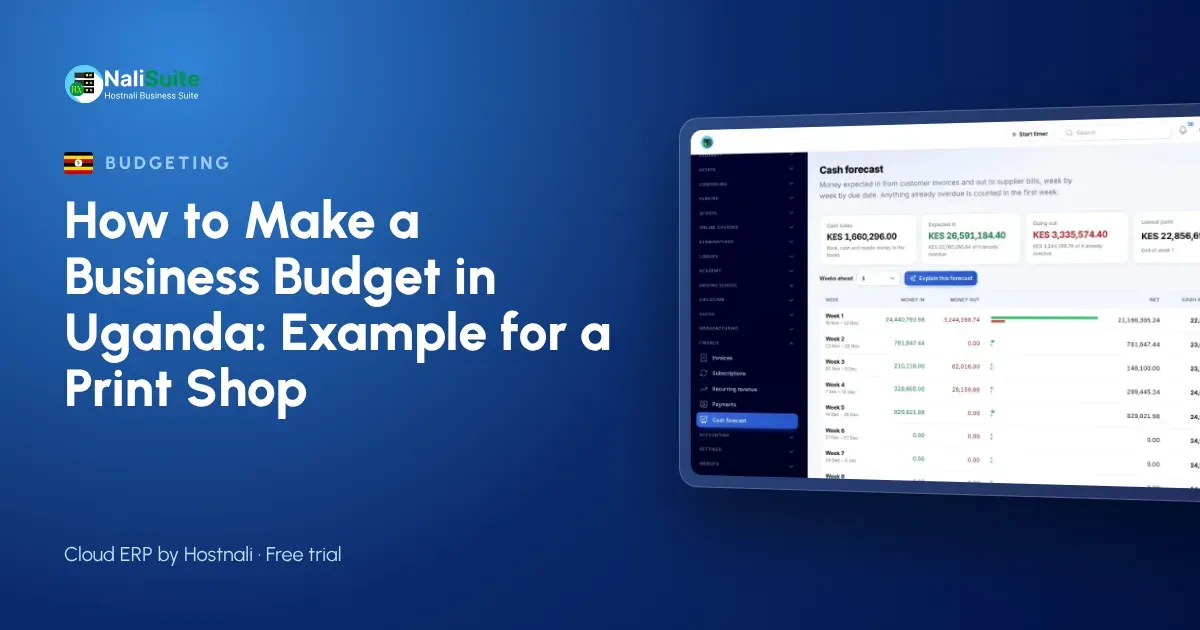
NaliSuite accounting stores budgets by account, department or project and compares them with actual results at any time. Invoices, bills, MTN MoMo and Airtel Money payments and payroll post themselves, so the figures are always up to date. Mobile money and bank reconciliation keeps them matched with your statements.
Frequently asked questions
Do I need special software to budget?
No; a spreadsheet works. Software helps because your actual figures fill in automatically, so you keep using the budget.
How do I budget for irregular big orders?
Put them in the month you expect them only when they are confirmed. Keep likely-but-unconfirmed orders in a note.
What should I do if the budget shows a loss?
Look at which months and lines cause it, then decide: raise prices, cut a cost, chase payments faster or delay an investment.
Try NaliSuite
NaliSuite keeps your budget, accounts, payroll and mobile money payments together, so you can see how the year is going against the plan. Plans start at UGX 8,500 a month, shown in shillings, with a free trial. Compare the plans.