 UGX
 KES - Kenya
 TZS - Tanzania
 RWF - Rwanda
 NGN - Nigeria
 ZAR - South Africa
 USD - Zimbabwe
 GHS - Ghana
 ETB - Ethiopia
 ZMW - Zambia
 USD - International

Marketing plans written for big companies run to dozens of pages. A small business in Kampala, Mbarara or Gulu needs something that fits on a single page and gets used. This article helps you write that page for email marketing, section by section, with examples from Ugandan businesses.
At the end you will have a plan you can stick on the wall: why you email, who you email, what you send, how often and how you stay within the Data Protection and Privacy Act.
Section 1: the goal
Write one sentence that finishes “Our emails exist to…”. Examples:
- A private school in Wakiso: “…keep parents informed and fill next term’s places early.”
- A car hire firm in Entebbe: “…win repeat bookings from companies and travellers.”
- An IT supplier in Kampala: “…remind business clients about upgrades, licences and services before they shop elsewhere.”
One goal keeps every email focused.
Section 2: the audience
Who exactly will read your emails? Write down your two or three main groups. A hardware supplier might list “contractors”, “home builders” and “schools and institutions”. These groups become segments later, so each can get emails that suit it.
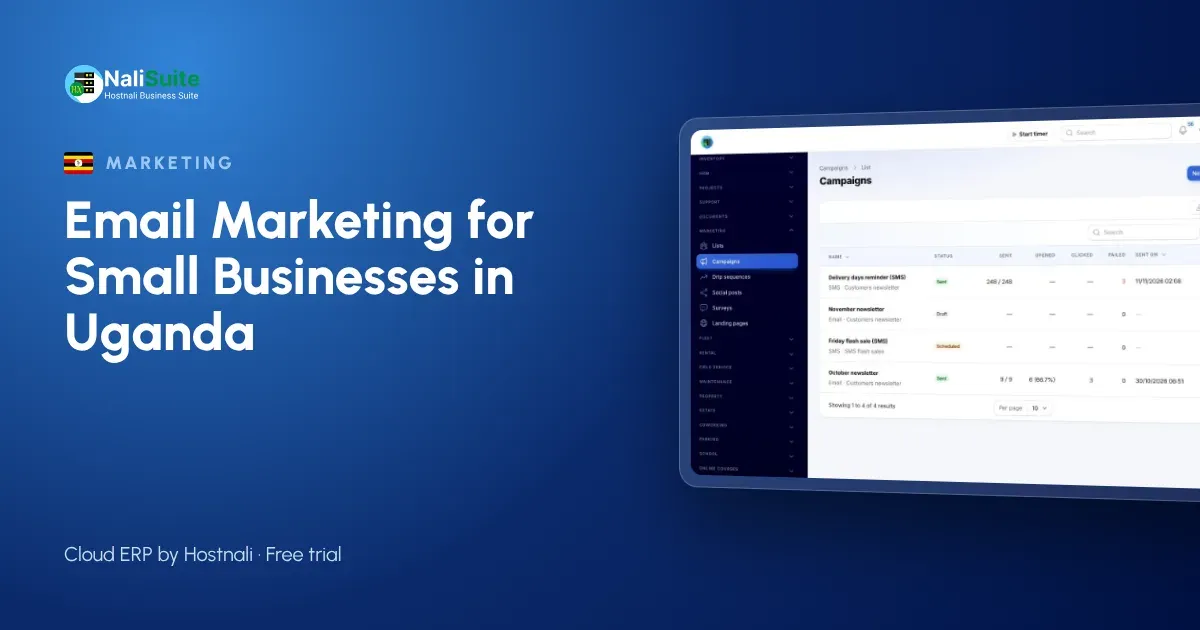
In NaliSuite, customers already live in the contacts app with tags and purchase history. The marketing app builds lists and segments from them.
Section 3: where the list comes from
Write down every place you will invite people to join:
- your existing customers, asked once and added only if they agree;
- a subscribe form or landing page on your website;
- a line on invoices, receipts and quotations;
- a QR code at your shop counter or event stand;
- a pinned post on your social media pages.
Also write what you will never do: buy lists or add people who did not agree.
Section 4: what you will send
List four kinds of email you can write without struggling:
| Kind | Ugandan example |
|---|---|
| Helpful | “How to keep your solar batteries healthy in the dry season” |
| Product | “New stock of laptops for students, with prices” |
| Proof | “How we set up a clinic’s network in Jinja” (with the client’s permission) |
| Offer | “Free delivery in Kampala this week” |
Each email gets one main message, one button and a clear way to pay or book: MTN MoMo, Airtel Money, card or a visit to your shop.
Section 5: the sender
Decide who the email comes from and from which address. A real name and a business address on your own domain build trust and help delivery, for example “Grace at Pearl Office Supplies” sending from an address on your own .co.ug or .com domain. Hostnali’s email hosting gives you mailboxes on your domain, and our team can help with the SPF, DKIM and DMARC records that help mail reach the inbox.
Section 6: the channel mix
Email carries detail. Shorter channels support it:
- SMS for short reminders, through a supported SMS provider connected to the marketing app;
- WhatsApp broadcasts using approved templates, only to customers who opted in (see WhatsApp in NaliSuite);
- Surveys such as NPS to see how customers feel.
Write down which channel does which job, so customers are not flooded with the same message three times.
Section 7: the schedule
A realistic schedule for a small business:
- every month: one helpful email and one product or offer email;
- when someone joins: an automatic welcome sequence of three emails over a week (drip sequences in NaliSuite start on their own);
- every quarter: a short customer survey.
Put the dates in your calendar for the next three months.
Section 8: how you will measure
Choose one main number that matches your goal: enrolment enquiries, bookings, orders or quotation requests. Then check opens and clicks to learn what interests people. Because marketing, the CRM and sales share the same records in NaliSuite, you can see which contacts clicked and then bought.
Review the numbers once a month and change one thing at a time.
Section 9: the rules
Uganda’s Data Protection and Privacy Act, 2019, and its 2021 regulations, overseen by the Personal Data Protection Office (PDPO), apply to the names and addresses on your list. Write these rules on your plan:
- we add people only with their consent and record it;
- every email has an unsubscribe link (NaliSuite adds one and skips opted-out contacts);
- we act on opt-outs and data requests promptly;
- we check the PDPO’s guidance, including whether we must register.
A filled-in example
Goal: fill next term’s places early. Audience: current parents, enquiring parents. List: parents who opted in at registration, website form. Send: term news, open day invitations, fee reminders. Sender: the school’s admissions office address. Channels: email for news, SMS for reminders. Schedule: two emails a month, open-day sequence each term. Measure: enquiries and enrolments. Rules: consent recorded, unsubscribe in every email.
Frequently asked questions
Is a small list worth emailing?
Yes. A small list of interested customers often brings more sales than a large list of strangers.
What is a good time to send?
Test it. Business customers often read on weekday mornings; consumers in the evening.
Can I send SMS campaigns as well?
Yes, once a supported SMS provider is connected to the marketing app.
Is the marketing app included in every plan?
Yes. It is one of the built-in NaliSuite apps, from UGX 8,500 a month.
Try NaliSuite
Turn your one-page plan into real campaigns. See the NaliSuite plans and start a free trial.