 UGX
 KES - Kenya
 TZS - Tanzania
 RWF - Rwanda
 NGN - Nigeria
 ZAR - South Africa
 USD - Zimbabwe
 GHS - Ghana
 ETB - Ethiopia
 ZMW - Zambia
 USD - International

Introduction
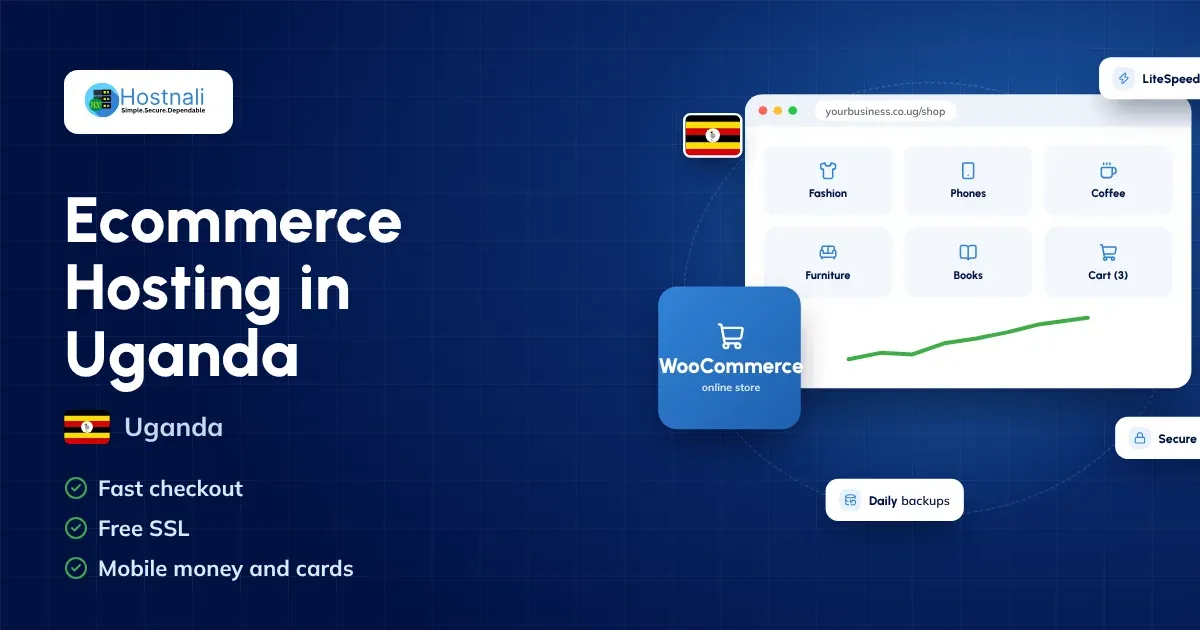
Opening an online shop in Uganda has never been easier. Whether you sell clothes, phones and accessories, cosmetics, furniture, coffee, crafts or school supplies, an ecommerce website lets you reach buyers well beyond your street or market. You can show your products, take orders, accept online payments and arrange deliveries without depending only on a physical shop.
Building a store is about more than picking a design and uploading product photos, though. Your shop needs reliable web hosting to keep its pages online, show products properly and support customers while they browse and buy.
The wrong hosting package can mean slow product pages, checkout errors, surprise resource limits and a hard time recovering the site after a technical problem.
This guide explains how to choose the best ecommerce hosting in Uganda in 2026, which features matter most, how WooCommerce works, and what Ugandan businesses should check before buying a hosting plan.
What Is Ecommerce Hosting?
Ecommerce hosting is the web hosting used to store and run an online shop. It gives you the server resources and technical environment for your website, product pages, images, shopping cart, checkout and the databases behind them.
When a customer opens your store, the server delivers the pages to their browser. When they add a product to the cart or place an order, the website also has to process that information and talk to its database.
A good ecommerce hosting setup should support:
- Reliable availability.
- Fast product and category pages.
- Secure connections through HTTPS.
- A shopping cart and checkout.
- Database work and order processing.
- Backups and a way to restore them.
- Business email on your own domain.
- More resources as the shop grows.
The right package depends on your catalogue, expected traffic, platform and budget.
Why Ecommerce Hosting Matters for Ugandan Online Businesses
Your website is part of the shopping experience. A shop can have great products and fair prices and still lose sales if visitors cannot browse comfortably or finish checkout.
1. Faster product browsing
Shoppers often open several product pages before they decide. If images load slowly or category pages hang, especially on a mobile data connection, many visitors leave before they reach your best products.
Hosting is one part of speed. Design, image sizes, plugins, caching and the visitor’s own connection matter too.
2. A smoother checkout
Customers expect the cart and checkout to just work. Your hosting must give the website, its database and your payment integration enough resources to run together.
Hosting alone cannot guarantee that a payment goes through. Your payment provider, website settings and the customer’s connection all play a part.
3. More customer confidence
People are more comfortable buying from a site that uses HTTPS, shows clear business details and explains delivery, returns and privacy.
A secure connection protects information sent between the customer’s browser and your site. Use reputable payment integrations and do not collect sensitive payment details you do not need.
4. Room to grow
A small shop may start with a handful of products and a few visitors a day. As your marketing works and orders grow, the site may need more processing power, memory or storage.
A provider with clear upgrade options makes that growth much easier.
Which Ecommerce Platform Should You Use in Uganda?
Before you buy hosting, decide which platform you will use. Each has its own technical needs and level of flexibility.
WordPress and WooCommerce
WordPress is a content management system for building and running a website. WooCommerce is a plugin that adds online shopping to WordPress.
Together they give you:
- Product pages and categories.
- A shopping cart and checkout.
- Stock and order management.
- Product variations such as sizes and colours.
- Coupons and special offers.
- Delivery settings.
- Payment gateway integrations.
- Extensions for marketing and reports.
WooCommerce is worth considering if you want full control of your shop and the freedom to add features later.
For example, a Kampala fashion boutique can use variations for sizes and colours, show product photos, track stock and set delivery options for different parts of the country.
Your hosting must meet the requirements of WordPress, WooCommerce, your theme and your plugins. Hostnali’s WooCommerce hosting is set up for exactly this.
Hosted ecommerce platforms
Hosted platforms bundle site-building tools and hosting into one subscription. They can suit businesses that want a managed environment and less technical work.
Before choosing one, compare the monthly cost, which payment options work in Uganda, transaction fees, how far you can customise the shop and how easily you can export your data if you leave.
Custom-built ecommerce websites
A custom store may suit a business with special workflows or integrations that standard tools cannot handle.
Custom development usually needs a bigger budget and ongoing technical support, and the hosting has to be chosen to fit the application’s design, traffic and resources.
8 Features to Look for in Ecommerce Hosting in Uganda
Not every hosting package suits an online shop. Check these features before you decide.
1. Reliable uptime
Uptime is the time your website stays reachable. Frequent outages stop customers from seeing products or placing orders.
Compare the provider’s published uptime guarantee, its service level terms and how outages are reported. Ask what is excluded and whether service credits apply. Hostnali offers a 99.99% uptime guarantee with service credits set out in its Terms of Use.
No provider can promise every site is online every second, so read the actual terms rather than just the headline number.
2. SSD or NVMe storage
Storage holds your files, product images, databases and email.
SSD storage performs well, and NVMe SSD storage can be faster still. Storage is only one part of speed, though: server configuration, CPU and RAM, caching and how the site is built also count. Hostnali’s shared plans use NVMe SSD storage on LiteSpeed servers.
Check how much storage you get and whether backups count towards it.
3. Enough CPU and RAM
CPU and RAM let your site process requests. Ecommerce sites use more of them when customers browse, search, update carts and check out.
A small shop can run well on a good shared hosting plan. A busy shop with a large catalogue or heavy plugins may need a higher plan or VPS hosting.
Do not pick a package on storage alone. Look at resource limits and upgrade paths.
4. SSL certificate and HTTPS
HTTPS encrypts what passes between a visitor’s browser and your website, and it needs an SSL/TLS certificate.
Choose hosting that includes a free SSL certificate and lets you set up HTTPS properly. Make sure it renews on its own and that every page, image and script loads securely.
An SSL certificate does not make a whole shop secure. You still need updates, strong passwords, sensible access controls and safe payment integrations.
5. Regular backups
A backup is a copy of your files and database that helps you recover from an accidental deletion, a failed update, malware or another problem.
Before you buy, ask:
- How often are backups taken?
- How long are they kept?
- Are they stored away from the live website?
- Can you restore the site yourself?
- Is restoring included or charged separately?
Hostnali’s shared hosting includes automated daily backups, with one daily, one weekly and one monthly restore point. Keep your own extra copy outside the hosting account too, and test a restore before you need one.
6. WordPress and WooCommerce compatibility
If you plan to use WooCommerce, confirm that the hosting meets the current requirements of WordPress, WooCommerce, your theme and your payment plugin.
Check the PHP versions on offer, database support, HTTPS and whether you can manage files and databases yourself. One-click installers such as Softaculous and caching tools such as LiteSpeed Cache make the job easier.
A plan labelled “WordPress hosting” is a good start, but the actual resources and features still matter.
7. Support and troubleshooting
When checkout breaks, you need to know whether the cause is the hosting, WordPress, a plugin, the payment provider or something else.
Choose a provider that explains clearly how to reach support, when it is available and what it covers. Hostnali offers 24/7 support by live chat and ticket.
8. Room for expansion
Pick a provider that can grow with you. Later you may need more storage, more processing power, staging tools, stronger caching or a move to a VPS.
Check upgrade prices and migration help before you commit to a long plan.
How Much Does Ecommerce Hosting Cost in Uganda?
The total depends on the hosting package, domain, platform, design, extensions, payment integration and the support you need.
Hostnali web hosting starts from UGX 74,120 a year, a .co.ug domain is UGX 221,000 a year and a .com is UGX 60,520. Bigger or managed setups cost more, so treat the hosting as one line in a wider budget.
Your budget may include:
| Expense | What to consider |
|---|---|
| Domain name | Registration price and renewal price |
| Web hosting | Storage, resources, security and support |
| Website design | Theme customisation or professional development |
| Ecommerce platform | WooCommerce itself or a paid hosted platform |
| Plugins and extensions | Delivery, marketing, reports and other features |
| Payment integration | Provider fees and any setup costs |
| Website maintenance | Updates, backups, security and troubleshooting |
| Marketing | Product photos, content, advertising and promotions |
The core WooCommerce plugin is free, but you will still pay for hosting, a domain, any premium extensions, design work and payment processing fees.
Always check renewal prices, taxes, resource limits and exactly what is included before you buy. Every shared plan except Starter includes a free domain.
To see Hostnali’s packages and current prices, visit Hostnali web hosting.
How to Set Up an Online Store Using WordPress and WooCommerce
If you are building your very own online shop, this order of work is a practical place to start.
Step 1: Register a good domain
Choose a name that is easy to spell, remember and link to your business. Many Ugandan businesses choose a .co.ug domain, while .com can suit a brand that also sells abroad. See our guide on choosing a domain name.
Check availability and renewal prices on domain registration before you register.
Step 2: Buy compatible hosting
Pick a package that supports WordPress and gives enough resources for your catalogue and traffic.
You can compare packages on the Hostnali WooCommerce hosting page.
Step 3: Install WordPress and WooCommerce
Install WordPress from your hosting account (Softaculous in cPanel does it in a few clicks), then add WooCommerce and follow its setup wizard.
Set your shop’s country, currency (Uganda shillings), product settings, delivery zones and other key options.
Step 4: Add products and clear information
Write helpful product titles and descriptions. Upload properly sized photos and add prices, sizes or variations, stock levels and delivery details.
Publish your contact details, a privacy policy, terms and conditions, and a returns or exchange policy that fits your business. If you collect customer details, read up on your duties under the Data Protection and Privacy Act, 2019.
Step 5: Set up payments and deliveries
Choose a payment provider that supports your business and the ways your customers like to pay. Many Ugandan shoppers prefer mobile money such as MTN Mobile Money or Airtel Money, alongside cards. Check that the provider you choose supports the checkout and settlement process you want.
Set delivery fees, delivery areas, pick-up points and expected delivery times, for example same-day delivery in Kampala and a few days upcountry.
Never assume a payment integration comes with your hosting. It usually needs its own merchant account, plugin and setup.
Step 6: Secure and test the store
Turn on HTTPS, use strong admin passwords, keep software updated and confirm your backups.
Test the whole journey on a phone and a computer: browsing, variations, adding to cart, checkout, payment confirmation, order emails and delivery details.
Use your payment provider’s test mode, if it has one, before taking real money.
Step 7: Watch performance after launch
Check page speed, error logs, storage and resource use. Look at abandoned carts and customer feedback to see what to improve.
As traffic grows, compress product images, use caching and review whether your plan still fits.
Common Ecommerce Hosting Mistakes to Avoid
Buying the cheapest package without checking limits: A low price is tempting, but thin resources, strict policies or high renewals cause trouble later.
Ignoring renewal prices: An introductory offer does not show what it costs to keep your shop online for several years.
Installing too many plugins: Unneeded or abandoned plugins add security risk and slow the site down.
Uploading huge product photos: Large images slow category and product pages. Resize and compress them before uploading.
Skipping backups: A backup only helps if it exists and can be restored when you need it.
Thinking SSL is complete security: HTTPS protects data in transit, but the shop still needs secure admin access, updates, monitoring and safe payment handling.
Not testing checkout: A site can look fine while payment notifications, delivery settings or order emails are broken. Test the full process regularly.
Waiting until the shop is slow to upgrade: Watch resource use and plan upgrades before customers notice problems.
Is Shared Hosting Enough for an Online Store?
Shared hosting is a sensible start for a small shop with modest traffic, a manageable catalogue and a sound setup.
Shared hosting places several accounts on one server, and resources and usage rules differ by provider and plan.
A growing shop may need a bigger plan or VPS hosting if it has steady high traffic, heavy database work or keeps hitting limits. A VPS usually means more responsibility for setup and administration unless you choose a managed VPS.
The best choice is not always the most expensive one. It is the package that fits your needs today and gives you a clear path to grow.
Why Consider Hostnali for Your Ecommerce Website?
Hostnali serves businesses across Uganda that want to start or grow their online presence. When you consider Hostnali for a shop, look at the current packages and confirm the features your store needs.
Every shared plan includes NVMe SSD storage, LiteSpeed servers and LiteSpeed Cache, free SSL, cPanel with Softaculous, WordPress staging and auto updates, unlimited email accounts, daily backups and a 30-day money-back guarantee on hosting. Moving an existing shop is free, and you can pay by card, bank transfer or mobile money.
Start on the Hostnali homepage and compare plans. Before buying, confirm the package supports your platform and your payment integration.
The aim is hosting that keeps the shopping experience dependable, protects your business data and grows with your customer base.
Frequently Asked Questions About Ecommerce Hosting in Uganda
1. Which hosting is best for ecommerce in Uganda?
It depends on your platform, traffic, catalogue, budget and technical needs. Compare uptime terms, resources, SSL, backups, support and upgrade options before you choose.
2. Can I run an online store on shared hosting?
Yes. A good shared plan can run a small shop with modest traffic. Check the resource limits and watch performance as you grow.
3. Is WooCommerce suitable for Ugandan businesses?
Yes, WooCommerce suits Ugandan businesses that want to manage products, orders and content in WordPress. Check that your payment provider and delivery process work with it.
4. Can I accept mobile money on my ecommerce website?
Yes, if you use a payment provider or integration that supports mobile money and set it up correctly. Check transaction fees, settlement times, supported payment flows and plugin compatibility with the provider.
5. Do I need an SSL certificate for my online store?
Yes, your shop should use HTTPS, which needs an SSL/TLS certificate. Hostnali includes free SSL on every hosting plan. Keep other security measures in place as well.
6. How much does ecommerce hosting cost in Uganda?
Hostnali web hosting starts from UGX 74,120 a year. Compare the full renewal price and extra costs such as domains, extensions, payment fees, backups and maintenance.
7. Can I upgrade my hosting package later?
Yes. With Hostnali you can move to a bigger plan or a VPS as you grow. Ask about upgrade prices and whether any downtime is expected during a move.
8. What should I back up on my ecommerce website?
Back up both the files and the database. The database holds your products, orders and settings. Keep a separate copy where you can and test restoring it.
Final Thoughts
Choosing ecommerce hosting in Uganda is a key decision for any business selling online. Your hosting should keep the shop reachable, connections secure, product pages quick and checkout working, with room to grow.
Start with your platform and budget. Then compare resources, storage, SSL, backups, support, renewal prices and upgrade options. If you use WordPress and WooCommerce, confirm they work with your theme, plugins and payment provider before you commit.
Good hosting, clear product information, secure payments and regular maintenance give your online shop a strong base for serving customers across Uganda.
Ready to build your online store? Explore Hostnali’s WooCommerce hosting and choose a package that fits your shop.